
Last Updated: 08 Jul 2026
ActiveCampaign Review (2026): Is It Still Worth It?
I have used ActiveCampaign across real businesses for years.
Not a trial account. Not a sponsored test. Real email lists, real automations, real money going to this platform every single month — and enough experience with it to tell you exactly where it earns that money and where it does not.
ActiveCampaign is the most talked-about email automation tool in the mid-market. It holds a 4.5 out of 5 rating across more than 16,000 reviews on G2 and Capterra combined. The automation builder is consistently called the best in its price range. And 180,000 businesses pay for it every month.
But in 2026, there are things about ActiveCampaign that are harder to defend than they used to be.
The November 2025 billing change. The Starter plan that is barely usable for real marketing. The price increases that have hit some users by nearly 100% over three years without meaningful new features to show for it. The support experience that depends entirely on which plan you are on and which rep you get.
I am going to give you an honest picture of all of it — what ActiveCampaign does better than anyone else, what it gets wrong, and who should actually be using it.
My Overall Rating
ActiveCampaign: 4.1 out of 5
It earns that score because the automation is genuinely the best in this price range and the deliverability is the highest in independent testing. It loses points for the Starter plan trap, the November 2025 billing change, the learning curve that takes real investment, and support quality that degrades sharply once you leave the higher tiers.
Start your free activecampaign now
Who Is ActiveCampaign Best For?
Before I get into features, let me be direct about who this tool is actually built for — because signing up for the wrong reason is the most common source of disappointment in the reviews I read.
ActiveCampaign is best for:
Businesses where email marketing is an active part of how they generate and nurture leads — SaaS companies, service businesses, agencies, B2B companies, and ecommerce brands that send more than a basic newsletter. If you want your emails to react to what subscribers actually do — clicking a link, visiting a page, buying a product, moving to a new deal stage — and you want those reactions to trigger specific follow-up sequences automatically, this is the right tool.
ActiveCampaign is not right for:
Complete beginners who just want to send a monthly newsletter. Businesses on a very tight budget who cannot afford Plus. Anyone who only needs basic sequences and will never touch the advanced features. For those use cases, you are paying for capability you will never use — and there are better-value options.
Ease of Use
Rating: 3.5 out of 5
The first time you log in, ActiveCampaign surprises you in a good way. The dashboard is cleaner than you expect for a platform this feature-heavy. Campaigns, automations, contacts, deals, and reports all sit in a clear left sidebar. Setup takes about five minutes.
Then you try to build your first automation.
The visual automation builder looks simple at a glance — a drag-and-drop canvas with triggers, actions, and conditions. But once you start adding branches, conditions, goal steps, and split paths, the complexity reveals itself fast. Learning Curve is the most mentioned complaint on G2, appearing in over 400 reviews. That is not a coincidence.
Most users describe needing two to four weeks before they feel confident using the platform properly. Not two to four hours — weeks. One G2 reviewer described spending significant time on trial and error because their workflows did not behave as expected. Another described the documentation as often sparse or out of sync with the current interface, which made onboarding harder than it needed to be.
The honest truth is that ActiveCampaign’s complexity is the cost of its power. The same depth that lets you build incredibly specific customer journeys is what makes the first sessions disorienting.
The 2025 and 2026 interface updates have made things slightly better. More templates. Better progressive disclosure that shows relevant features as you advance rather than dumping everything at once. The AI Automation Builder that generates workflow drafts from plain-language prompts has reduced build time significantly for users who have moved past the initial learning phase.
One fair criticism from recent reviews: some users say the recent updates have made the platform feel more AI-heavy and less human. If your preference is a straightforward interface that feels familiar and predictable — the push toward AI-first workflows may not suit you.
💡 Better option for ease of use: MailerLite or Kit — both have significantly gentler learning curves for users who do not need ActiveCampaign’s automation depth.
Email Builder
Rating: 4 out of 5
ActiveCampaign’s drag-and-drop email editor is fast, flexible, and well-designed for a platform primarily known for automation.
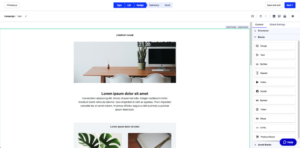
You can build multi-column layouts, adjust individual content blocks, change colours and fonts, embed images, and customise every section without touching any code. The editor feels responsive — changes happen in real time and the undo function works reliably, which sounds basic but matters after you have spent time in editors that do not.
The AI Brand Kit is genuinely useful. You paste your website URL and ActiveCampaign pulls your colours, fonts, and logo and applies them to templates automatically. That is a one-time setup that pays back time on every campaign you build after it.
Conditional content blocks let you show different sections to different subscribers inside the same email — based on their tags, behaviour, or custom fields. You can send one email that reads completely differently to a new lead than it does to a returning customer. That is a real personalisation capability, not just a segmentation filter.
Split testing supports up to five variations simultaneously with automatic winner selection. Most platforms cap you at two. The difference matters when you are running tests across large lists and want statistically meaningful data faster.
The honest limitations: the editor does not have as many interactive content elements as some competitors — no native survey blocks, no countdown timers, no image carousels. And some users find the HTML editing mode harder to work with than dedicated HTML editors. These are gaps that affect specific use cases rather than the majority of users.
Template Library
Rating: 4 out of 5
ActiveCampaign gives you over 900 email templates. That is the largest template library of any platform in this price range by a significant margin.
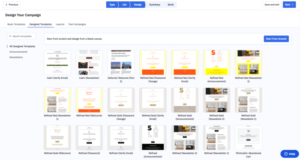
The templates cover newsletters, promotional campaigns, lead nurture sequences, re-engagement emails, product announcements, ecommerce flows, event invitations, and more. They are organised by category and industry so finding a starting point for a specific campaign type takes minutes rather than scrolling through endless options.
The quality is consistently good — professionally designed, mobile-responsive, and varied enough that you will rarely need to build from scratch. You can also save your own branded layouts as reusable templates, so the designs you have invested time in are always one click away.
The AI template generation tool builds an email draft from a plain-language description of what you want to send. The output needs editing but kills the blank page problem reliably.
The honest limitation is that despite the volume, the templates do not match the visual impact of tools like Flodesk for brand-forward design. If aesthetics are the primary reason you are choosing an email platform, ActiveCampaign is not the tool for that specific need.
Automation
Rating: 5 out of 5
This is where ActiveCampaign earns its reputation — and where the honest conversation about which plan you actually need to access it becomes critical.
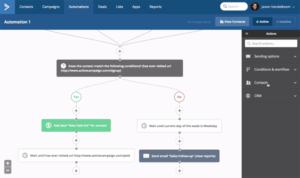
The automation builder itself:
The visual builder works on a canvas where you connect triggers, conditions, actions, and branches. You can build workflows triggered by email opens, clicks, website page visits, form submissions, purchases, custom field updates, tag additions, deal stage changes, and actions in connected apps. The conditional branching supports multiple paths based on any combination of those conditions.
Goal tracking lets you define what conversion looks like for a sequence — a purchase, a page visit, a deal stage — and automatically move subscribers forward when they achieve it rather than waiting for the time delay to expire. That is a level of workflow intelligence that most competitors do not have.
The 900+ pre-built automation recipes cover almost every common use case. A full abandoned cart sequence, a multi-touch lead nurture flow, a post-purchase follow-up, a re-engagement campaign — all available as starting points you adapt rather than build from zero.
The AI Automation Builder generates complete multi-step workflow drafts from plain-language descriptions. You describe what you want to accomplish in a few sentences and ActiveCampaign builds the structure. It reduces build time dramatically for users who know what they want but do not want to construct every step manually.
A G2 reviewer who had been on the platform for nine years called out Message Variables as the feature that keeps them loyal — edit one variable once and it updates across every email in every sequence that uses it. For teams running recurring campaign templates like webinar sequences or launch funnels, this saves hours every month.
The Starter plan problem:
Here is where I have to be blunt.
The Starter plan caps automation at five actions per workflow. Five. A basic welcome sequence that sends an email, waits two days, sends a follow-up, waits three more days, and sends a final email is already five actions. Add any conditional logic and you are over the limit immediately.
The Starter plan is not where the product people describe when they recommend ActiveCampaign actually lives. Plus is where it lives — at $49 a month for 1,000 contacts on annual billing. If you are comparing plans and trying to justify the $15 Starter tier, stop. You will hit the ceiling within a week and either upgrade or feel like the platform is broken.
Budget for Plus from day one. The Starter plan exists for trials, not real marketing.
💡 Better option if you need simpler automation: MailerLite covers welcome sequences, re-engagement campaigns, and standard ecommerce triggers at $10 to $20 a month without the plan-tier complexity.
Segmentation and Contact Management
Rating: 4 out of 5
ActiveCampaign’s segmentation is one of the platform’s clearest strengths. You can filter contacts by email behaviour, website visits, purchase history, tags, custom fields, lead scores, CRM deal data, and actions in connected apps. Conditions can be stacked with AND/OR logic to build very specific groups.
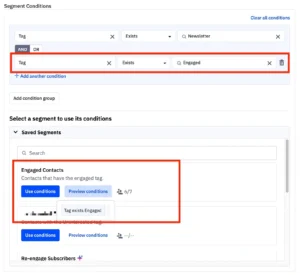
The AI-suggested segment builder is one of the most useful practical features in the 2025/2026 updates. You describe the audience you want in plain language and the platform builds the filter. What used to take manual setup and testing now takes a couple of minutes.
The Message Variables feature is worth calling out specifically in the context of list management. If you run recurring campaigns — quarterly product launches, annual event sequences — you edit the variable once and it updates across every email in every automation that references it. This saves real time at scale.
The single contact model is a meaningful structural advantage. One contact exists once in ActiveCampaign regardless of how many tags, lists, or automations they belong to. No duplicate billing across separate audiences. No risk of emailing the same person twice from two separate lists.
The November 2025 billing change — the one thing that genuinely hurts this category:
Before November 2025, ActiveCampaign charged only for active subscribers. A contact who unsubscribed was not billable.
After November 2025, new accounts are charged for all contacts — including unsubscribed, bounced, and unconfirmed. This mirrors the Mailchimp billing practice that has been widely criticised for years.
If you are signing up today with an existing list that has any churn history, your billable contact count will be higher than your emailable contact count. The only way to manage this is to actively archive inactive contacts — and archiving has monthly limits based on your plan tier.
Actively archiving contacts is now a non-negotiable habit rather than an occasional housekeeping task. Factor that into your operational workflow before you sign up.
Pre-November 2025 accounts are grandfathered on the old billing. If you are an existing customer and your billing has not changed, you are on the better model.
CRM and Sales Tools
Rating: 3.5 out of 5
ActiveCampaign’s built-in CRM is available on Plus and above. You get deal pipelines, contact scoring, task management, win probability tracking, and the ability to tie email automation directly to deal stage changes.
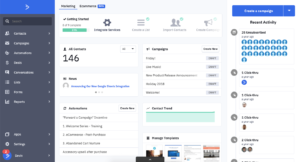
A deal moving to a new stage can trigger an automation. A contact reaching a lead score threshold can move them into a new pipeline. A form submission can create a new deal automatically. That tight loop between marketing activity and sales tracking is what makes ActiveCampaign useful for B2B companies and service businesses where there is a genuine sales process behind the email marketing.
The practical value is real for small sales teams. One G2 reviewer described the lead scoring as making the marketing-to-sales handoff dramatically clearer — sales reps knew exactly which contacts to prioritise without manual review because the scoring did the sorting automatically.
The honest assessment: the CRM earns a 3.5 rather than higher for a reason. Independent testing from a founder who used ActiveCampaign across eight companies over twelve years scored the CRM 2.5 out of 5. It works well for automation-connected sales tracking. It is not a replacement for Salesforce, HubSpot, or any serious CRM for teams with complex operations, multiple pipeline stages, or forecasting requirements.
The add-on pricing is also worth knowing. The Pipelines add-on starts at $49 a month on top of the base Plus plan. The Sales Engagement add-on starts at $85 a month. A business paying Plus plus both add-ons is spending $183 a month before subscriber-based scaling — significantly more than the headline Plus price suggests.
💡 Better option for CRM: HubSpot’s free CRM is more capable for businesses that need serious sales pipeline management and can accept email marketing at a basic level in return.
Forms and Landing Pages
Rating: 3.5 out of 5
ActiveCampaign gives you embedded forms, floating bars, pop-ups, and modal windows. Every form submission can immediately trigger an automation, add tags, update a deal, or send an internal notification. The connection between form fills and the automation engine is tight and works reliably.
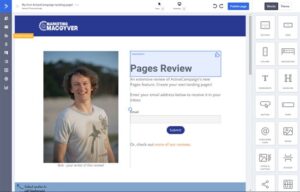
Landing pages are available on Plus and above. The builder is functional, supports dynamic content on Pro and higher — showing different page versions to different visitor types based on who they are or what they have done — and connects directly to automation workflows.
The honest limitations: landing pages feel like an add-on to the core product rather than a deeply developed feature. The template selection is smaller than dedicated landing page tools. The builder does not have the same polish as the email editor.
On Starter, there are no landing pages at all. Mailchimp includes landing pages from its $13 Essentials plan. If landing pages are important to your marketing and budget is a constraint, ActiveCampaign’s plan gate here is a real disadvantage compared to Mailchimp’s more accessible landing page access.
Deliverability
Rating: 5 out of 5
This is the clearest win in the entire review.
Independent deliverability testing from EmailTooltester puts ActiveCampaign at 94.2% inbox placement — first overall across all platforms tested. That is the highest score of any major email platform in recent independent testing.
The platform includes built-in spam testing, list hygiene tools, an Inbox Tracker showing where emails land across 15+ inbox providers, and strict account review processes that keep low-quality senders off shared IP infrastructure. That last point matters: when the senders sharing your IP reputation are held to high standards, everyone’s deliverability benefits.
In practical terms, on a list of 50,000 contacts, a 94.2% deliverability rate means roughly 47,100 emails reach the inbox per send. At Mailchimp’s 82 to 88% rate, that number drops to 41,000 to 44,000. The difference is 3,000 to 6,000 emails per send — every single time you hit send.
Over a year of weekly sends, that compounds into a significant amount of missed opens, missed clicks, and missed revenue.
Integrations
Rating: 4.5 out of 5
ActiveCampaign connects to over 900 apps natively. Shopify, WooCommerce, Salesforce, HubSpot, Stripe, Calendly, WordPress, Typeform, and most tools that businesses across any industry rely on are covered.
The API is well documented for custom connections. The Zapier and Make integrations expand options significantly for anything not natively supported.
In late 2025, ActiveCampaign became the first email marketing platform in the Claude MCP partner directory — meaning it can connect with external AI tools in ways most email platforms cannot yet. That is forward-looking infrastructure that will matter more as AI-assisted marketing becomes standard.
The honest gap: 900 is the total count, not all equal in depth. Some integrations are deep two-way syncs. Others are basic one-directional data pushes. Always check the specific integration documentation for the tools you actually use before assuming the connection does what you need.
Reporting and Analytics
Rating: 3.5 out of 5
ActiveCampaign gives you campaign performance metrics, automation performance reports, contact-level engagement history, and deal revenue tracking through the CRM. The reporting connects email activity to sales outcomes in a way that Mailchimp and MailerLite cannot match.
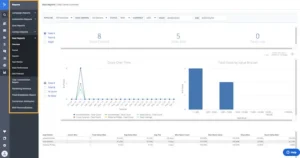
The practical value for B2B teams: you can see which email sequences led to closed deals, which automations are generating pipeline, and which contacts are most engaged — all from connected dashboards rather than separate tools.
The honest limitations: custom reporting is a paid add-on starting at $159 a month on top of the base plan. For businesses that need deep cross-campaign analytics, that is a meaningful extra cost. Without it, the standard reporting is solid but not comprehensive.
A/B testing on automations — testing different workflow paths against each other — is not natively available in the way some users expect. You can split test email broadcasts. Testing which automation branch performs better requires workarounds rather than a built-in feature.
Multiple G2 reviewers describe reporting as either overkill or hard to interpret depending on their experience level. The data is there. Finding and using it is not always intuitive.
Customer Support
Rating: 3 out of 5
This is the most polarising category in ActiveCampaign’s reviews — and the honest picture is not flattering for the majority of users.
What the plan tiers get you:
Starter gets email support. Plus gets chat support. Professional and Enterprise get priority support plus one-on-one strategy sessions. Free migration assistance is available on Plus and above — they move your contacts and rebuild your automations when you switch from another platform.
The honest problems:
First — ActiveCampaign claims 24/7 support. The actual support hours are Monday to Friday from 3am to 11pm Central Time, and Sundays from 6pm to 11pm Central. That is not 24/7. For a platform at this price, that is a misleading claim.
Second — support quality varies enormously by plan. Starter and lower Plus users consistently describe being pointed to help documentation rather than getting direct assistance with specific problems. One Trustpilot reviewer described it as “next to impossible to get through to a person.” Another described being told they needed to pay $79 for a support call — beyond their included plan. These are not isolated complaints.
Third — cancellation. Multiple Capterra and Trustpilot reviewers describe being unable to downgrade or cancel without going through a “specialised team” process that takes days and multiple follow-up messages. One reviewer described wanting to downgrade and being told they could not until their next annual renewal — a full year away. That kind of friction at cancellation is a serious trust issue.
Fourth — the knowledge base documentation does not always match the current interface. Multiple reviewers describe following step-by-step guides that refer to UI elements that no longer exist in the current version. For a platform with a steep learning curve, outdated documentation makes the learning process harder than it needs to be.
The platform support experience is genuinely good for Professional and Enterprise users. For everyone else, it is below what the price tag should deliver.
💡 Better option for support: MailerLite offers 24/7 email support on its $10 Growing Business plan and 24/7 live chat on its $20 Advanced plan — meaningfully more accessible for small businesses at lower price tiers.
Pricing: The Full Honest Picture
Rating: 3 out of 5
Let me give you the real numbers — not just the plan names and headline prices.
The four plans:
The Starter plan starts at $15 a month for 1,000 contacts on annual billing. Five automation actions per workflow. One user seat. No landing pages. No CRM. No lead scoring. This plan is barely usable for real marketing. Multiple reviewers describe signing up, building their first welcome sequence, and hitting the five-action ceiling within days. Treat this as an extended trial, not a working plan.
The Plus plan starts at $49 a month for 1,000 contacts on annual billing. Unlimited automation actions, landing pages, lead scoring, SMS marketing, the CRM, and up to three user seats. This is where ActiveCampaign actually starts delivering on its reputation. For most businesses evaluating ActiveCampaign, Plus is the real starting point.
The Professional plan starts at $149 a month for 1,000 contacts. Predictive sending, site messaging, conversion attribution, split automation, and up to five users.
The Enterprise plan starts at $259 a month for 1,000 contacts. Custom reporting, HIPAA compliance, dedicated account manager, custom mail server domains, and unlimited users.
How Plus plan costs scale by contact count:
- 1,000 contacts: $49 a month
- 2,500 contacts: $95 a month
- 5,000 contacts: $149 a month
- 10,000 contacts: $189 a month
- 25,000 contacts: $369 a month
- 50,000 contacts: $469 a month
Email send limits — the thing most reviews do not mention:
ActiveCampaign caps monthly email sends based on your plan. Starter and Plus cap at 10x your contact count. Professional caps at 12x. Enterprise at 15x. On Plus at 1,000 contacts, that means you can send 10,000 emails a month. If you have 1,000 contacts and send more than weekly on average — you could hit this limit. It is not a dealbreaker for most businesses but it is worth knowing before you plan your send schedule.
The November 2025 billing change — again:
New accounts created after November 3, 2025 are charged for all contacts — subscribed, unsubscribed, bounced, and unconfirmed. If you are signing up today, your billable contact count will exceed your emailable contact count on any list with churn history.
Pre-November 2025 accounts keep the old active-contact-only billing as long as they stay. If you are an existing customer on the old model — do not switch plans unless you have to, as plan changes may reset your billing terms.
The price increases:
One Capterra reviewer with a long-term account described price increases of nearly 100% over three years. A Reddit thread from 2024 described a 30% price increase during a plan migration with no clear communication beforehand. These are not outlier complaints — they reflect a pattern of pricing adjustments that has affected long-term customers more than new ones.
The add-on stack:
The base Plus plan is $49. Add the Pipelines CRM add-on: $49 more. Add Sales Engagement: $85 more. Add custom reporting: $159 more. A Plus account with CRM and custom reporting is spending $257 a month before subscriber-based scaling. That is a very different number from the $49 headline.
What I Tested Personally
I used ActiveCampaign across multiple business accounts including a service business with a lead nurture sequence, an ecommerce account with abandoned cart and post-purchase flows, and a SaaS account with trial-to-paid conversion automations.
What worked exactly as promised:
The automation builder. Every condition I set up behaved correctly. Every branch triggered on the right action. The goal tracking moved contacts forward automatically when they converted without waiting for the next time delay. This is the core product and it delivers.
The deliverability. Open rates on the accounts I managed through ActiveCampaign were consistently above what the same lists had seen on previous platforms. That is hard to attribute to a single variable — but the deliverability data supports it.
The CRM-to-automation connection. Building a workflow where a contact scoring above 50 automatically created a deal and moved it to “Qualified Lead” — and then triggered an email from the assigned sales rep — took about 45 minutes to set up and worked cleanly from the first test.
What frustrated me:
The Starter plan five-action cap. I tested it specifically to understand the experience a new user would have. You hit the ceiling on a basic welcome sequence and there is no clear in-product explanation of why the automation stopped building — just a greyed-out option that requires investigation to understand.
The documentation gaps. Several times I tried to follow a knowledge base article for a specific automation setup and the interface had changed since the article was written. I had to find the answer in the community forum instead.
The support response on a Plus account I managed. A question about the November 2025 billing change took two days to get a clear answer on. For a billing question with real financial implications — that is too slow.
ActiveCampaign Pros and Cons
What I genuinely like:
The automation builder is the best I have used in this price range. The depth of conditional logic, the goal tracking, the 900+ pre-built recipes, and the AI workflow generator are a genuine competitive advantage that no competitor has fully matched below enterprise pricing.
Deliverability at 94.2% is the highest in independent testing. That translates directly into more emails reaching the inbox, more opens, and more revenue from the same list.
The single-contact model is cleaner than Mailchimp’s multi-audience structure. One person, one record, one billing entry regardless of how many lists or automations they belong to.
The CRM integration for B2B businesses closes the loop between marketing and sales in a way that email-only tools cannot.
What I do not like:
The Starter plan is close to unusable for real marketing. It exists to get people in the door at a low price point, not to be a functional starting plan.
The November 2025 billing change for new accounts is a disappointing move that mirrors Mailchimp’s most criticised billing practice.
Prices have risen significantly over the past three years. Long-term users have absorbed increases that, in some cases, doubled their monthly cost. There has not been a proportional improvement in features to justify that trajectory.
Support quality varies too much by plan level. Users on Starter and lower Plus describe an experience that does not match what the platform’s price and reputation suggest.
The documentation does not always match the current interface. On a platform with a genuine learning curve, that makes the learning harder than it needs to be.
Some users find the recent AI-heavy direction a step away from the more hands-on, human feel the platform had before. That is a preference issue rather than a flaw — but it is a real sentiment worth acknowledging.
My Final Verdict
ActiveCampaign earns its reputation for one specific thing: marketing automation at a price that is not enterprise.
If you run a business where email needs to react to what people do — click links, visit pages, buy products, move through a sales process — and you are willing to invest two to four weeks in learning the platform properly, ActiveCampaign gives you more capability for the money than any direct competitor I have tested.
The Starter plan is a trap. The support at lower tiers is below what the price should deliver. The November 2025 billing change is a real problem that deserves the same criticism Mailchimp has received for years. And the price increases over the past three years have made the value proposition harder to defend for businesses that have not been growing their lists proportionally.
But the automation builder still delivers. The deliverability still leads the market. The CRM still closes the loop for B2B businesses in a way no email-only tool can match.
Go in with Plus from day one. Budget for what the platform actually costs at your real contact count, not the headline $15 number. And keep your list clean — because the November 2025 billing change means inactive contacts are not free to store anymore.
My score: 4.1 out of 5
Frequently Asked Questions
Is ActiveCampaign worth it in 2026?
For businesses that need serious marketing automation — yes. The automation builder is the best in its price range and the deliverability leads independent testing at 94.2%. For businesses that just need basic newsletters or simple sequences, it is more platform than you need and there are better-value options.
What is the real starting price for ActiveCampaign?
The Starter plan is $15 a month for 1,000 contacts on annual billing — but the five-action automation cap makes it nearly useless for real marketing. The Plus plan at $49 a month is where the platform most users describe actually starts. Budget for Plus from day one.
Does ActiveCampaign charge for unsubscribed contacts?
For accounts created after November 3, 2025 — yes. New accounts are billed for all contacts including unsubscribed, bounced, and unconfirmed. Accounts created before that date are grandfathered on active-contact-only billing.
How long does it take to learn ActiveCampaign?
Most users describe two to four weeks before they feel confident using the automation builder and advanced features properly. Basic campaigns and simple sequences can be set up much faster — but the platform’s real value requires investment in learning the conditional logic and automation architecture.
Does ActiveCampaign have a free plan?
No. ActiveCampaign offers a 14-day free trial with no credit card required. There is no permanent free tier. If a free plan is a requirement, MailerLite offers a free plan for up to 1,000 subscribers and Kit offers one for up to 10,000.
Can I cancel ActiveCampaign easily?
Based on recent reviews — no. Multiple users describe cancellation requiring contact with a “specialised team” and taking several days. Downgrading between plans on an annual commitment is also restricted until renewal. Know this before you commit to an annual plan.
Is ActiveCampaign good for ecommerce?
Yes — particularly for Shopify and WooCommerce stores that need abandoned cart flows, post-purchase sequences, browse abandonment, and product-triggered automations. The integration depth is not as strong as Klaviyo for advanced ecommerce segmentation and real-time store data, but for most mid-size stores the ActiveCampaign ecommerce features are more than adequate.
What is the best alternative to ActiveCampaign?
It depends on your need. MailerLite for a similar feature set at a lower price with an easier learning curve. Klaviyo for deep ecommerce automation on Shopify or WooCommerce. HubSpot for a full platform connecting marketing, sales, and service if budget allows. Brevo for email and SMS marketing with a contact-storage-based pricing model that is often cheaper for large lists.
