
Last Updated: 05 Jul 2026
I have tested both ActiveCampaign vs Klaviyo on real businesses with real email lists.
Not a demo account. Not a five-minute feature tour. Real campaigns, real automations, and real money going to one platform every single month.
And here is what most comparison posts will not tell you upfront: ActiveCampaign and Klaviyo are not competing for the same customer.
ActiveCampaign is built for businesses that want the most powerful automation engine available at a reasonable price — across any industry, any business model, any audience type.
Klaviyo is built for one thing only: online stores. Every feature, every automation, every report inside Klaviyo is designed around shopping behavior and driving revenue from your store.
Picking the wrong one does not just cost you features. It costs you money you cannot get back — and time rebuilding everything on a different platform six months later.
Let me break down exactly where each tool wins, where each one has real problems, and which one is actually right for how you work.
Short on Time? Read Activecampaign vs Klaviyo quick summary
ActiveCampaign is the best marketing automation tool for businesses that are not online stores.
Klaviyo is the best email and SMS tool for online stores — if you can manage the cost as your list grows.
Quick Comparison
| If You Want… | Choose |
|---|---|
| The most powerful automation builder at a fair price | ActiveCampaign |
| A built-in CRM with deal tracking and sales pipelines | ActiveCampaign |
| Automation that works for any business type, not just stores | ActiveCampaign |
| 900+ app connections out of the box | ActiveCampaign |
| Deep Shopify integration with real-time store data | Klaviyo |
| Abandoned cart, browse abandonment, and win-back flows built in | Klaviyo |
| Predictive analytics — customer lifetime value, churn risk | Klaviyo |
| Email and SMS in one platform with ecommerce-specific triggers | Klaviyo |
Who Should Choose ActiveCampaign?
ActiveCampaign is the right choice for service businesses, SaaS companies, agencies, coaches, B2B companies, and anyone who needs serious marketing automation without being tied to an online store.
The automation builder is the best in its price range — period. You get deep conditional logic, CRM-connected workflows, lead scoring, and the ability to build sequences that react to almost any behavior imaginable. If email automation is the engine of your marketing, ActiveCampaign gives you the most control over how that engine runs.
Who Should Choose Klaviyo?
Klaviyo is the right choice if you run an online store — specifically on Shopify, WooCommerce, or BigCommerce — and email is a key part of how you drive revenue.
The Shopify connection syncs product catalogs, browsing behavior, purchase history, and cart data in real time. The 80+ pre-built flows cover abandoned carts, post-purchase sequences, win-back campaigns, browse abandonment, and back-in-stock alerts. Predictive analytics tell you each customer’s expected next order date, churn risk, and predicted lifetime value.
No other platform at this price does ecommerce email as well as Klaviyo.
The Honest Warning About Both Tools
ActiveCampaign changed its billing in November 2025. New accounts are now charged for all contacts including unsubscribed and bounced ones. If you have a large, older list with inactive contacts — you are paying for people you cannot email.
Klaviyo changed its billing in February 2025. It moved from charging based on emails you send to charging based on every active profile in your account — whether you email them or not. One marketer described their bill jumping from $150 to $890 in one month after this change. Suppressed contacts, contacts from integrations you barely use, and contacts you re-engage briefly all count and keep counting for three billing cycles before you can remove them.
Klaviyo’s advertised price is not what most growing stores actually pay. More on this in the pricing section.
My Final Take
If you run an online store: Klaviyo — nothing competes with its ecommerce depth.
If you run anything else: ActiveCampaign — better automation, better value, and a CRM that Klaviyo simply does not have.
But if budget is a concern for your store — read to the end. There are two tools that do 80 to 90 percent of what Klaviyo does for a fraction of the cost.
What I Tested and How
I used both platforms on real accounts — building automation workflows, connecting stores, running campaigns, and digging into the reporting on both sides.
I also went through hundreds of verified reviews on G2, Capterra, and Trustpilot — specifically looking at long-term users who have been on each platform for six months or more. The honeymoon reviews tell you what a tool promises. The six-month reviews tell you what it actually delivers.
Here is everything I found.
Ease of Use
ActiveCampaign: Powerful but takes real time to learn
ActiveCampaign is not a beginner tool. I want to be honest about that upfront.
The dashboard is clean and the navigation makes sense once you learn it. But the first time you open the automation builder — with its triggers, conditions, actions, branches, and paths — it is genuinely overwhelming. Most users need two to four weeks before they feel comfortable building sequences without second-guessing every decision.
“Learning Curve” is the most mentioned complaint on G2 — appearing in over 400 reviews. That is not a minor note. It is the honest price of using a tool this deep.
The good news: once it clicks, it is fast. The pre-built automation recipes, AI tools, and template library reduce build time significantly once you know where everything lives. ActiveCampaign says its AI tools have cut average campaign build time from 2.6 hours to 18 minutes. I cannot verify that exact number, but the direction is right.
Klaviyo: Clean interface, but ecommerce complexity hides underneath
Klaviyo’s interface is well-designed. The dashboard is clear. Getting started with a basic flow is faster than ActiveCampaign.
But Klaviyo’s simplicity is surface-level. The segmentation system — with its nested conditions, predicted metrics, behavioral filters, and real-time updates — takes real time to learn well. Multiple G2 reviewers describe the platform as overwhelming for beginners, especially if you do not have dedicated email marketing experience.
The template editor has also drawn consistent complaints. Several G2 users mention not being able to set background images properly — they either look distorted, too large, or have obvious repeat lines. For an ecommerce tool where visual design matters, that is a frustrating limitation.
One honest note from ecommerce marketers who have tried both: most Shopify stores that start on ActiveCampaign eventually switch to Klaviyo. Very few go the other way. The ecommerce pull is real.
Winner: Klaviyo for an easier first experience. ActiveCampaign once you are past the learning curve and using the full automation depth. Neither tool is simple at the level where it earns its price.
Email Builder
ActiveCampaign: One of the best email builders in this price range
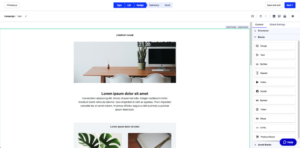
ActiveCampaign’s drag-and-drop editor is fast, flexible, and consistently rated well by users who have tried multiple platforms.
You can build multi-column layouts, adjust individual content blocks, add images, and customize colors and fonts without touching any code. The editor also supports conditional content — meaning different subscribers see different things inside the same email based on their tags, behavior, or custom fields.
The AI Brand Kit lets you paste in your website URL and ActiveCampaign applies your colors, fonts, and logo to templates automatically. Predictive sending figures out the best delivery time for each individual contact based on their past opening patterns — not just time-zone optimization, but person-by-person optimization.
Split testing goes up to five variations at once with automatic winner selection. Most tools give you two.
Klaviyo: Good editor with specific weaknesses
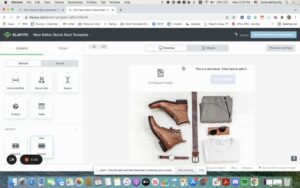
Klaviyo’s email builder is solid. The drag-and-drop interface works well for standard layouts. The AI content generation helps speed up copy creation.
The real advantage is the product feed integration. Klaviyo pulls your store’s product catalog directly into the email editor — so you can build emails that automatically show recently viewed products, recommended items, or back-in-stock alerts without manually inserting product images and links every time. For a store sending frequent product emails, that saves significant time every week.
The honest weaknesses: the template editor struggles with background images, as mentioned by multiple G2 users. And outside of ecommerce-specific content blocks, the editor offers less design freedom than ActiveCampaign.
Winner: ActiveCampaign for design flexibility and split testing depth. Klaviyo if dynamic product blocks and catalog-connected emails are central to how you communicate with customers.
Template Library
The template library is what saves you time every week. And here the two tools take different approaches — with different tradeoffs depending on what you actually need to send.
ActiveCampaign: 900+ templates across every campaign type
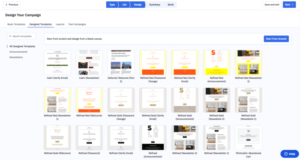
ActiveCampaign gives you over 900 email templates. Newsletters, product launches, welcome sequences, re-engagement campaigns, event invitations, seasonal promotions — there is a starting point for almost any email you would ever need to send.
The templates are professionally designed, mobile-responsive, and organized by category and industry. You can also save your own branded layouts as reusable templates, which means your best designs are always one click away.
The AI template generation tool builds a draft from a plain-language description. The output needs editing, but it kills the blank page problem quickly.
For non-ecommerce businesses — SaaS companies, agencies, coaches, service businesses — this template variety is genuinely hard to beat at this price.
Klaviyo: Fewer general templates, stronger ecommerce-specific designs
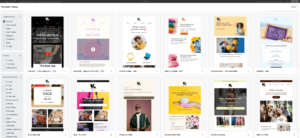
Klaviyo’s template library is smaller than ActiveCampaign’s in total number, but every template is built around ecommerce use cases. Product launches, back-in-stock alerts, review requests, price drop notifications, cross-sell sequences, and seasonal campaigns all have specific templates designed around how customers shop.
The real standout is the dynamic product blocks that are baked into the templates themselves. Instead of building a product recommendation section manually every time you send, Klaviyo templates can pull in products from your catalog automatically based on what each customer has viewed or purchased.
For a Shopify store sending frequent product emails — that dynamic content in templates is more valuable than having 900 generic options to choose from.
The honest limitation: if you need a template for something that is not store-related — a plain newsletter, a service announcement, a B2B follow-up sequence — Klaviyo’s library is thin.
Winner: ActiveCampaign for volume and variety across all business types. Klaviyo for ecommerce-specific templates with dynamic product content built in.
Automation
This is the most important section in the comparison. And it is where the two tools are most clearly built for different people.
ActiveCampaign: The best automation builder in its price range
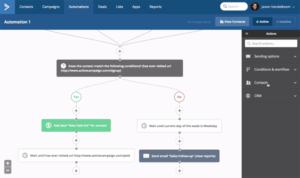
ActiveCampaign’s visual automation builder is the reason 180,000 businesses pay for the platform. It is, in my testing and in the consensus of independent reviewers, the most flexible email automation tool available below enterprise pricing.
You can build workflows triggered by email opens, clicks, website page visits, form submissions, purchases, custom field changes, tags, deal stage updates, and actions inside third-party tools. The branching logic supports dozens of conditional paths inside a single automation — reacting differently to every possible subscriber behavior.
The pre-built automation recipes — 900+ of them — mean you are not starting from scratch for common use cases. A full abandoned cart sequence, a re-engagement campaign, a lead scoring system, a multi-step product launch sequence — all available as templates you adapt rather than build from zero.
The AI automation features added in 2025 and 2026 are genuinely useful. AI-suggested segments use plain language to build contact groups. AI-generated automation recipes build workflow drafts from text prompts.
The honest limitation: the Starter plan caps automations at five actions each. Five. That is so restrictive it makes the Starter plan almost useless for real marketing. Budget for Plus from day one — that is where the real automation lives.
Klaviyo: Best ecommerce automation available, narrow outside of stores
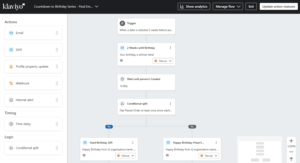
Klaviyo calls its automations “flows.” And for ecommerce, these flows are as good as it gets.
The 80+ pre-built flows cover abandoned cart, welcome series, post-purchase education, win-back campaigns, browse abandonment, back-in-stock alerts, price drop notifications, and subscription renewal reminders. The flow builder reacts to real shopping behavior in real time — when someone adds to cart on your Shopify store, Klaviyo knows within seconds.
The predictive analytics layer is what makes Klaviyo’s automation genuinely unique. For each customer, Klaviyo generates a predicted next order date, a churn risk score, and a predicted lifetime value. You can build automation logic around these predictions — reaching customers before they churn rather than after.
Where Klaviyo’s automation hits a wall: anything outside ecommerce. There is no CRM, no deal pipeline, no lead scoring for B2B scenarios, and no cross-department automation that connects marketing to sales to support. The trigger set is narrower than ActiveCampaign’s because it is designed for store events, not general business workflows.
A wholesale kitchen distributor, a consulting firm, a SaaS company — Klaviyo’s automation does not serve these businesses well. ActiveCampaign does.
Winner: ActiveCampaign for automation flexibility across any business type. Klaviyo for ecommerce automation depth — abandoned cart, browse abandonment, post-purchase, and predictive flows are simply better than what ActiveCampaign can build for stores.
Segmentation and Contact Management
How you sort and organize your contacts determines how personal your emails feel. Both tools do this well — but they do it differently.
ActiveCampaign: Deep logic, flexible across any data type
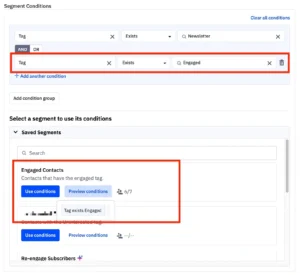
ActiveCampaign’s segmentation lets you filter contacts by email behavior, website visits, purchase history, tags, custom fields, lead scores, CRM deal data, and actions inside connected apps.
The conditions you can combine are extensive. You can build a segment like “contacts who visited the pricing page AND have a deal value over five thousand dollars AND have not been contacted in seven days” and trigger a specific automation from that exact combination.
The AI-suggested segment builder lets you describe what you want in plain language and builds the filter for you. That used to take significant manual setup. Now it takes about two minutes.
The November 2025 billing change is worth addressing here directly: new accounts are charged for all contacts including unsubscribed and bounced. That means inactive contacts inflate your bill unless you actively archive them. Archiving has monthly limits. It is a real management burden that did not exist before November 2025, and it makes list hygiene a non-negotiable habit rather than an occasional task.
Klaviyo: The deepest ecommerce segmentation available
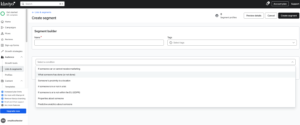
Klaviyo processes over 350 behavioral data points per contact, including purchase history, product category preferences, browsing behavior, RFM scores (how recently, how often, and how much someone has bought), and predicted next order date.
The segment builder supports nested conditions, relative date ranges, and real-time updates. Segments refresh automatically as customer behavior changes — you do not need to manually refresh anything.
For stores with large customer bases and diverse product catalogs, this level of data-driven segmentation enables genuinely personal campaigns. If you sell both twenty-dollar accessories and five-hundred-dollar premium items, you can tailor messaging by customer tier based on actual spending patterns — not just what list they signed up on.
The February 2025 billing change introduced a real problem here. Klaviyo now charges for every contactable profile in your account whether you market to them or not. Suppressed contacts still count. Contacts that come in from integrations you barely use still count. They stay on your bill for three billing cycles before you can remove them. One user described their bill jumping from $150 to $890 in a single month after this change.
Winner: Klaviyo for ecommerce segmentation depth — the behavioral data tied to store activity is unmatched. ActiveCampaign for non-ecommerce businesses and flexible multi-condition logic. Both tools have billing changes since early 2025 that make list hygiene significantly more important than it used to be.
CRM and Sales Tracking
ActiveCampaign: A real CRM baked into the platform
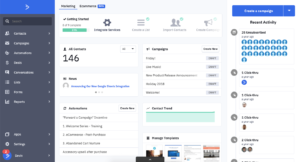
ActiveCampaign includes a built-in CRM on Plus and above. You get deal pipelines, contact scoring, task management, win probability tracking, and the ability to connect email automation directly to deal stage changes.
A deal moving to “Proposal Sent” can automatically trigger an email sequence. A contact scoring above a certain threshold can move them into a new pipeline stage. That kind of tight connection between marketing automation and sales tracking is what makes ActiveCampaign genuinely useful for B2B companies and service businesses.
It is not a replacement for Salesforce. But for a small sales team that wants to track deals alongside email marketing without paying for a separate CRM tool — it works well.
Klaviyo: No CRM at all
Klaviyo has no CRM. No deal pipelines. No sales tracking. No task management. No way to connect email marketing activity to a sales conversation or a deal stage.
If you need to track what happens after someone clicks an email — whether a sales rep followed up, whether a deal is moving forward, whether a proposal is out — you need a completely separate tool alongside Klaviyo.
For pure ecommerce where transactions happen automatically without a sales team, this is fine. For any business with a sales process, it is a real gap.
Winner: ActiveCampaign — by default. Klaviyo simply does not have this.
Forms and Landing Pages
ActiveCampaign: Multiple form types, connected to the automation engine

ActiveCampaign gives you embedded forms, floating bars, pop-ups, and modal windows. Every form submission can immediately trigger an automation, add tags, update a deal, or send an internal notification.
Landing pages are available on Plus and above. The builder is functional, supports dynamic content on Pro and higher, and connects directly to your automation workflows. The template selection is smaller than dedicated landing page tools, but it gets the job done for most use cases.
Klaviyo: Ecommerce-specific forms with gamification options
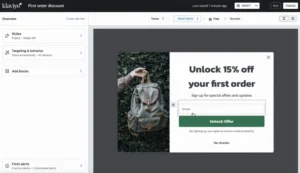
Klaviyo’s form builder is built around growing an ecommerce list. You get pop-ups, embedded forms, and flyouts — all designed with store conversion in mind. The gamification options, like spin-to-win wheel pop-ups that offer discount codes for signing up, are genuinely effective for ecommerce list growth.
Forms connect directly to flows. Someone signs up with a pop-up, gets tagged based on what they were browsing, and enters a welcome sequence that shows them products related to what they just looked at. That kind of connected experience is tight and fast to set up in Klaviyo.
Landing pages are more basic in Klaviyo. It is not where the platform invests its development effort.
Winner: ActiveCampaign for landing page capability and form variety. Klaviyo for ecommerce-specific pop-ups and list growth forms connected to store behavior.
Deliverability
This is the number that matters more than any feature list. If your emails do not reach the inbox, nothing else works.
Independent deliverability testing from EmailTooltester gives ActiveCampaign a score of 94.2% — ranking it first overall out of all platforms tested.
Klaviyo scores 5 out of 5 on deliverability ratings from EmailTooltester for its monitoring tools and inbox tracking. It has a dedicated Deliverability Hub that shows account-level deliverability scores, domain analytics, bounce tracking, and sender reputation in more detail than most competing platforms.
Both tools have strong deliverability infrastructure. Klaviyo’s monitoring tools give you more visibility into what is happening with your inbox placement. ActiveCampaign’s raw deliverability scores are slightly higher in independent testing.
The honest caveat on both: deliverability is affected as much by your own practices as by the platform. List hygiene, proper email authentication setup (SPF, DKIM, DMARC), and keeping your engagement rates healthy matter as much as which tool you are using.
Winner: Tie — both platforms are strong. ActiveCampaign edges slightly higher in raw testing scores. Klaviyo offers better monitoring tools to manage your deliverability proactively.
Integrations
ActiveCampaign: 900+ integrations across every business type
ActiveCampaign connects to over 900 apps. Shopify, WooCommerce, Salesforce, HubSpot, Stripe, Calendly, WordPress, Typeform, and most tools that businesses across any industry use daily are all there. The API is well documented for custom connections.
In late 2025, ActiveCampaign became the first email marketing platform in Claude’s official MCP partner directory — meaning it can connect with AI tools in ways most email platforms cannot yet.
For a non-ecommerce business with a diverse tech stack — a SaaS company, an agency, a professional services firm — 900+ integrations means almost everything you use is covered without workarounds.
Klaviyo: 350+ integrations, deep within the ecommerce ecosystem
Klaviyo connects to 350+ apps. The library is smaller than ActiveCampaign’s in total, but every integration is chosen because it matters for online stores — review platforms like Yotpo and Okendo, loyalty apps like LoyaltyLion, subscription tools like ReCharge and Ordergroove, customer service platforms like Gorgias, and more.
The Shopify integration in particular is the benchmark that every other email platform is measured against. When you connect Klaviyo to Shopify, it syncs product catalogs, order history, browsing behavior, cart data, and customer profiles in real time — not a daily batch import, but real-time event capture that lets flows trigger within seconds of something happening in your store.
One important note: brands spending over $10,000 a month on Klaviyo are automatically enrolled in Klaviyo One, which adds a 20% fee on top of their total monthly spend. That is not disclosed prominently on the pricing page.
Winner: ActiveCampaign for total integrations and breadth across business types. Klaviyo for ecommerce-specific depth — the Shopify integration alone justifies the choice for serious stores.
Reporting and Analytics
ActiveCampaign: Strong email reporting, solid revenue tracking
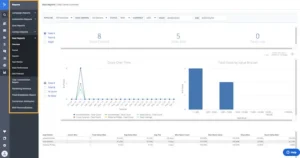
ActiveCampaign gives you detailed metrics for campaigns and automations: open rates, click rates, heat maps, engagement analytics, and deal reports that show how your sales pipeline is performing alongside your email activity.
For ecommerce users with connected stores, you get revenue attribution per campaign — which emails are actually generating sales, not just opens. The reporting dashboards cover email performance, automation performance, CRM activity, and contact engagement in one place.
On Professional and above, custom reporting lets you build dashboards around the specific metrics your business actually tracks. That add-on starts at $159 a month on top of the base plan — something to budget for if detailed cross-campaign analytics matter to you.
Klaviyo: Revenue-first reporting built for stores
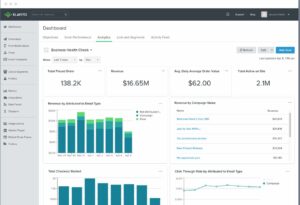
Klaviyo’s reporting is built around one question: how much money did this email make?
Revenue attribution is the core of every report. You can see exactly how much each campaign and each flow generated, with flexible attribution settings you can adjust and apply going back in time. Funnel reporting shows where customers drop off between seeing an email and completing a purchase. RFM analysis (recency, frequency, monetary value) helps you identify your best customers and your at-risk ones.
For ecommerce businesses trying to prove that email marketing drives real revenue — not just engagement — Klaviyo’s reporting makes that case more clearly than any other tool at this price.
The honest limitation: all the advanced reporting tools — Marketing Analytics with RFM, funnel reporting, and cohort analysis — are add-ons. Marketing Analytics starts at $100 a month for 13,500 active profiles. That is another line item on top of an already-scaling base plan cost.
Winner: Klaviyo for ecommerce revenue attribution and store-specific analytics. ActiveCampaign for businesses that need cross-functional reporting connecting email to sales pipeline performance.
Pricing: The Full Honest Picture
This is the section that changes the most minds. Let me give you the real numbers — not the headline prices.
ActiveCampaign Pricing
ActiveCampaign has four plans: Starter, Plus, Professional, and Enterprise.
The Starter plan starts at $15 a month for 1,000 contacts on annual billing. The catch: automation is capped at five actions per workflow. That is barely enough for a basic welcome email sequence. Treat this plan as a trial, not a real starting point.
The Plus plan starts at $49 a month for 1,000 contacts. This is where ActiveCampaign actually delivers. Full automation, landing pages, lead scoring, SMS marketing, and the CRM. For most businesses, this is the real starting point.
The Professional plan starts at $149 a month for 1,000 contacts. Adds predictive sending, site messaging, and split automation.
The Enterprise plan starts at $259 a month for 1,000 contacts. Custom reporting, dedicated support, HIPAA compliance.
How costs scale on Plus:
- 1,000 contacts: $49 a month
- 2,500 contacts: $95 a month
- 5,000 contacts: $149 a month
- 10,000 contacts: $189 a month
- 25,000 contacts: $369 a month
The November 2025 billing change: New accounts are charged for all contacts — subscribed, unsubscribed, and bounced. Pre-November accounts are on the old active-contact-only billing. If you are signing up today with an existing list that has churn history — your billable contact count will be higher than your emailable contact count.
Klaviyo Pricing
Klaviyo has three plans: Free, Email, and Email + SMS.
The Free plan gives you up to 250 active profiles and 500 email sends a month. It is useful for testing flows and getting set up, but any store with consistent traffic will outgrow it within weeks. Free plan users get email support for the first 60 days — then nothing.
The Email plan starts at $20 a month for up to 500 active profiles. This is the entry point most stores actually use.
The Email + SMS plan starts at $35 a month for 500 profiles. SMS credits are billed separately on top.
How costs scale on the Email plan:
- 500 profiles: $20 a month
- 1,000 profiles: $30 a month
- 2,500 profiles: $60 a month
- 5,000 profiles: $100 a month
- 10,000 profiles: $150 a month
- 25,000 profiles: roughly $400 a month
- 50,000 profiles: roughly $720 a month
- 250,000 profiles: $2,300 a month
The February 2025 billing change — the one Klaviyo did not advertise loudly:
Before February 2025, Klaviyo charged based on how many emails you actually sent. After February 2025, it charges based on every active profile in your account — whether you email them or not.
Suppressed contacts count. Contacts that came in from integrations you barely use count. Contacts you re-engage briefly stay on your bill for three billing cycles before you can remove them. Every integration you connect can dump contacts into Klaviyo and inflate your billable profile count without you realizing it.
One marketing consultant described their bill jumping from $150 to $890 in a single month after this change. Another described advertised pricing representing roughly 60 percent of their actual monthly bill once SMS, integration contacts, and add-ons were factored in.
There is also the Klaviyo One tier to know about: brands spending over $10,000 a month are automatically enrolled, which adds a 20% fee on top of their total monthly spend. This is not on the main pricing page.
The features do not change as you pay more. You get the same automation, the same segmentation, the same reporting at $20 a month and $720 a month. You are paying more because your list is bigger — not because you are unlocking anything new. That model works when revenue scales proportionally with list size. When it does not, the math stops making sense.
| List Size | ActiveCampaign Plus | Klaviyo Email |
|---|---|---|
| 1,000 contacts | $49 a month | $30 a month |
| 5,000 contacts | $149 a month | $100 a month |
| 10,000 contacts | $189 a month | $150 a month |
| 25,000 contacts | $369 a month | $400 a month |
At smaller list sizes, Klaviyo is cheaper. At 25,000 contacts, the lines cross and ActiveCampaign becomes the better deal. Factor in Klaviyo’s February 2025 billing change and the real cost gap for growing stores is often wider than this table shows.
Customer Support
ActiveCampaign: Support quality scales with your plan
Email support on Starter, chat support on Plus, priority support on Professional and Enterprise. Response times are generally good and the knowledge base covers most common issues.
The honest limitation: lower-tier users often get pointed to documentation rather than getting direct help with their specific situation. Priority support effectively starts at Professional.
On Pro and Enterprise, ActiveCampaign offers free migration — they move your contact lists, rebuild your automations, and transfer your templates when you switch from another platform. That is a meaningful offer for anyone with a complex setup.
Klaviyo: Decent on paid plans, poor on free and lower tiers
Klaviyo offers email and live chat support on paid plans. Live chat is only available weekdays from 9am to 5pm EST. Free plan users get email support for the first 60 days — after that, the help center and community forum are all you have.
Slow support response times show up consistently in long-term Klaviyo reviews. Multiple users describe being left without a timely answer to an urgent issue. For a platform this expensive and this important to store revenue, that is a real operational risk.
The Klaviyo Academy offers training, certifications, and live sessions — which helps reduce the learning curve and the need to contact support in the first place.
Winner: ActiveCampaign for overall support quality on paid plans. Neither platform does a great job supporting free-tier and entry-level users.
What Real Users Are Actually Saying
I went through hundreds of verified reviews on G2, Capterra, and Trustpilot — specifically looking for patterns in long-term reviews.
On ActiveCampaign’s automation depth:
The automation builder gets consistent, sustained praise from G2 reviewers who have been on the platform for more than a year. Users who have tried multiple email platforms before landing on ActiveCampaign describe it as the first tool that gave them full control over how their sequences react to subscriber behavior. One reviewer managing a SaaS company described building customer journeys that react to in-app behavior and email engagement simultaneously — something they had previously needed separate enterprise tools to accomplish.
On ActiveCampaign’s pricing surprise:
“Expensive” appears in over 400 G2 reviews — the second most mentioned complaint after learning curve. The specific frustration: people sign up expecting the $15 Starter price and discover the plan is essentially useless for real marketing. The jump to $49 Plus is where the real product lives — and the November 2025 billing change for inactive contacts has made that discovery more frustrating for users signing up today.
On Klaviyo’s ecommerce results:
The most compelling Klaviyo reviews come from Shopify store owners who describe it as the tool that changed how they think about email revenue. One G2 reviewer said Klaviyo drives 40 percent of their Shopify revenue through automated flows — abandoned cart, browse abandonment, and product recommendations running in the background without manual intervention. That kind of result is why serious ecommerce brands stay on Klaviyo despite the cost.
On Klaviyo’s pricing problems:
The February 2025 billing change shows up in enough reviews to be a clear pattern. Multiple users on Capterra and independent review sites describe being blindsided by bill increases that had nothing to do with adding new subscribers. Integration contacts, suppressed contacts, and re-engaged contacts all showing up on the monthly bill without clear warning. The complaint is not that Klaviyo is too expensive per se — it is that the cost is unpredictable and difficult to control.
On Klaviyo’s support quality:
Slow response times appear consistently in long-term Klaviyo reviews. Multiple users describe urgent issues sitting unresolved for longer than acceptable for a platform handling live store revenue. The community forum is helpful, but it is not a replacement for timely direct support when a high-revenue flow breaks.
My Honest Take After Testing Both
Here is where I land after testing both platforms on real accounts.
ActiveCampaign is the right choice for the vast majority of businesses that are not running ecommerce stores. The automation depth is real and accessible at a price that makes sense. The CRM integration is something Klaviyo simply cannot offer. The 900+ integrations cover any tech stack. And the deliverability track record is the best in independent testing.
The November 2025 billing change is a genuine problem — not enough to make me stop recommending ActiveCampaign for non-ecommerce businesses, but enough to make list hygiene a required habit rather than an occasional task.
Klaviyo is the right choice for serious Shopify and WooCommerce stores where email is a meaningful revenue channel and you are ready to invest time in learning the platform properly. The predictive analytics, the real-time Shopify integration, and the ecommerce-specific flow templates are genuinely better than anything ActiveCampaign has built for stores.
But the February 2025 billing change made Klaviyo meaningfully less friendly for smaller and mid-size stores. If you are under 10,000 contacts and not yet extracting serious revenue from email flows, you are likely overpaying for features you have not yet grown into.
If that last description sounds like your situation — read the next section before you commit.
Looking to Save Money Without Losing Features? Consider These Two Tools
Both ActiveCampaign and Klaviyo are serious platforms. But serious does not always mean right for your budget or your stage.
If you are running an online store and Klaviyo’s pricing feels steep — or if you tried it and the billing change blindsided you — there are two platforms worth looking at seriously before you commit.
Omnisend: The Best Alternative for Ecommerce Stores
Omnisend is built specifically for online stores and does about 85 to 90 percent of what Klaviyo does for significantly less money.
You get deep Shopify, WooCommerce, and BigCommerce integrations, abandoned cart flows, browse abandonment, post-purchase sequences, back-in-stock alerts, and product recommendation blocks in emails — all the core ecommerce automation that Klaviyo is known for.
The pricing model is more predictable. Standard starts at $16 a month for 500 contacts and 6,000 monthly emails. At 10,000 contacts, Omnisend costs around $100 to $132 a month compared to Klaviyo’s $150 — and Omnisend’s pricing does not have the integration-contact inflation issue that makes Klaviyo bills jump unexpectedly.
Omnisend also includes 24/7 support on all plans including the free one. Klaviyo only offers time-limited support to free plan users. That difference matters when something breaks at 11pm before a product launch.
Where Omnisend is not as strong: the predictive analytics layer — customer lifetime value predictions, churn risk scores, predicted next order dates — is not as deep as Klaviyo’s. And the segmentation, while solid, does not process the same volume of behavioral data points per contact that Klaviyo does.
For growing ecommerce stores that want serious email and SMS automation without Klaviyo’s price and billing unpredictability — Omnisend is the most direct alternative.
Brevo: The Best Alternative for Businesses That Need More Than Just Email
Brevo (formerly called Sendinblue) is the better choice if you are a small or mid-size business — not purely an ecommerce store — and you want email, SMS, WhatsApp messaging, live chat, and a basic CRM all in one place without paying ActiveCampaign prices.
Brevo’s pricing model works completely differently from ActiveCampaign and Klaviyo. It charges based on how many emails you send — not how many contacts you store. You can have 100,000 contacts in Brevo and pay nothing extra for storing them. You only pay when you actually send to them. For businesses with large lists that do not email everyone every week — or businesses that have accumulated contacts over years — this is dramatically better math.
The free plan includes 9,000 emails a month and up to 100,000 contacts stored. That is a genuinely useful free plan, not a demo.
Paid plans start at $9 a month for 5,000 emails. The Business plan at $18 a month adds full automation, advanced segmentation, and multi-user access. At 10,000 contacts sending twice a month, Brevo would cost around $25 to $69 a month compared to ActiveCampaign’s $189 — a difference of $120 to $164 a month, or up to nearly $2,000 a year.
Where Brevo is not as strong: the automation builder is capable but not as deep as ActiveCampaign’s. The template library is smaller (around 40+ templates). Advanced ecommerce features like back-in-stock alerts and AI product recommendations are locked behind the Professional plan at higher cost. And the CRM is basic — useful for simple sales tracking but not a replacement for ActiveCampaign’s pipeline management.
For businesses that need more than just email but do not want to pay ActiveCampaign prices — particularly businesses with large contact lists that send less frequently — Brevo offers more features for less money with a billing model that does not punish you for growing.
Frequently Asked Questions
Is ActiveCampaign better than Klaviyo?
For non-ecommerce businesses — yes. ActiveCampaign’s automation is more flexible, its CRM integration is something Klaviyo does not have, and its pricing is more straightforward. For ecommerce stores on Shopify or WooCommerce, Klaviyo’s depth of store data, predictive analytics, and ecommerce-specific flows are better than what ActiveCampaign can offer for product-based businesses.
Is Klaviyo worth the price?
For established Shopify stores where email is a meaningful revenue channel — often yes. The automation flows, predictive analytics, and real-time store data can generate significant additional revenue that justifies the cost. For smaller stores or businesses not yet using the advanced features, the price is harder to justify — especially after the February 2025 billing change.
What happened to Klaviyo pricing in 2025?
In February 2025, Klaviyo changed from charging based on emails sent to charging for every active profile in your account — whether you email them or not. Suppressed contacts, integration contacts, and re-engaged contacts all count and stay on your bill for three billing cycles. This caused significant bill increases for many businesses without any change in their actual list size.
Does Klaviyo have a CRM?
No. Klaviyo does not have deal pipelines, sales tracking, or task management. It tracks customer and marketing data for ecommerce purposes, but there is no sales CRM functionality. If you need to track deals alongside email marketing, ActiveCampaign is the better choice.
What is a cheaper alternative to Klaviyo for ecommerce?
Omnisend is the most direct alternative. It offers abandoned cart, browse abandonment, post-purchase, and back-in-stock flows with Shopify and WooCommerce integration at a lower and more predictable price than Klaviyo. It also includes 24/7 support on all plans. The trade-off is less depth in predictive analytics and behavioral segmentation.
What is a cheaper alternative to ActiveCampaign for non-ecommerce businesses?
Brevo charges by emails sent rather than contacts stored, which makes it significantly cheaper for businesses with large lists. Full automation is included from lower plan tiers, and the free plan gives you 9,000 emails a month and 100,000 contacts stored. The trade-off is a less deep automation builder and a smaller template library.
Can I use ActiveCampaign for my Shopify store?
Yes, but with limitations. ActiveCampaign integrates with Shopify and can trigger abandoned cart and post-purchase automations. The integration does not sync product catalogs, browsing behavior, or real-time inventory the way Klaviyo does. For basic store automations it works. For advanced ecommerce flows driven by real-time behavioral data, you will hit limits that Klaviyo does not have.
