If you think open rates don’t matter anymore, think again.
In 2025, email open rate is still the heartbeat of every successful campaign — the first signal that tells you whether your subject lines, send times, and audience targeting are working or not. Yet, open rates are changing fast. Privacy updates, AI-driven inbox filtering, and smarter email strategies are rewriting the benchmarks we’ve trusted for years.
That’s why we dove deep into the latest Email Open Rate Statistics (2026) — to uncover how often people actually open emails today, what’s driving those numbers, and how different industries, regions, and business types compare.
Whether you run an eCommerce brand, SaaS company, or newsletter business, this updated data will help you understand:
What a “good” open rate really means in 2025
Which industries are outperforming others
How factors like personalization, timing, and segmentation impact opens
And most importantly — how you can improve yours starting today
So before you send your next campaign, take five minutes to explore the insights below. You’ll walk away with fresh benchmarks, hidden patterns, and actionable takeaways to boost your open rates — and your email ROI — this year.
At Mailotrix, we carefully curated these email list building statistics from trusted and verified industry sources such as HubSpot, Statista, Campaign Monitor, GetResponse, Bluecore, and WebFX, along with the latest 2023–2026 reports and research studies.
Every stat included here was selected based on: ✅ Credibility — We only use data from reputable, verifiable sources. ✅ Relevance — Each stat directly supports email marketers, business owners, and creators who want to grow their lists. ✅ Recency — We focus on the latest available data to reflect current trends and results.
All statistics were cross-verified across multiple sources to ensure accuracy and consistency. This page is regularly updated to keep the information fresh and relevant for marketers like you.
Email Open rate Key Stats
📊 Segmentation & Personalization Stats
Segmentation isn’t optional — it’s the baseline.
Segmented campaigns deliver 14.31%–30% higher open rates than non-segmented emails.
78% of marketers say segmentation is the #1 driver of better email performance.
Behavior-based emails average 42.36% open rates, compared to 14.5%–26.9% for generic broadcasts.
Personalized subject lines increase opens by 22%–50%.
Simply adding the subscriber’s first name boosts opens by ~26%.
👉 Takeaway: If you’re still sending one-size-fits-all emails, you’re voluntarily cutting your open rates in half.
📨 Subject Lines, Sender Names & Preheaders
Your email is judged before it’s opened.
78% of people open emails because of the sender name, not the subject line.
Only 22% open based primarily on the subject line.
42%–68% of subscribers say the sender name is the first or most important factor they check.
Custom preheaders lift open rates to 44.67%, vs 39.28% without one.
24% of subscribers read preview text before deciding to open.
👉 Takeaway: Brand trust + smart preheaders often matter more than clever subject lines.
⏰ Best Day & Time to Send Emails
Timing still matters — but only after relevance.
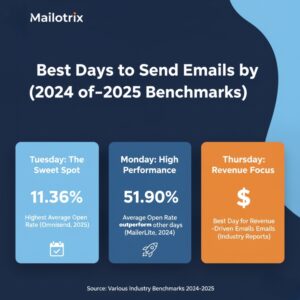
Tuesday consistently ranks as the best day for open rates across industries.
9:00 AM – 11:00 AM (local time) is the strongest sending window.
58% of adults check email first thing in the morning.
👉 Takeaway: Hit inboxes when people are alert — not buried under notifications.
📱 Mobile Email Behavior
Email is now a mobile-first channel.
50%–70%+ of email opens happen on mobile devices.
55%+ of opens spike during early mornings and evening commutes.
80% of people delete emails that don’t display properly on mobile.
👉 Takeaway: If your emails aren’t designed mobile-first, most subscribers will never read them.
🔁 Re-sends, Re-engagement & List Hygiene
More opens don’t require more subscribers.
Resending campaigns to non-openers increases total opens by 10%–30%, with some cases seeing up to 54.7% lift.
Dedicated re-engagement campaigns achieve 36%–42.51% open rates, compared to 14.5%–26.9% for standard broadcasts.
Maintaining a clean email list improves open rates by 5%–15%.
👉 Takeaway: Email performance improves fastest when you optimize who you send to — not how often.
🧪 Testing, Deliverability & Trust Signals
Optimization compounds — guessing doesn’t.
Emails that undergo A/B testing see 49% higher open rates than untested campaigns.
~10.5% of legitimate emails still land in spam due to filtering.
BIMI logos increase open rates by 10%–20%+, with some studies showing 21%–39% lifts.
👉 Takeaway: Trust signals + testing protect your emails from both spam folders and low engagement.
🌍 Language, Platforms & Dark Mode
Context matters more than creativity.
55% of consumers are more likely to buy when emails are written in their native language.
Apple Mail accounts for 49.79% of all email opens.
Gmail holds 28.16% market share.
82.7% of OS users prefer dark mode.
Bounce rates dropped by 21% for emails optimized for dark mode.
👉 Takeaway: Designing for Apple Mail, Gmail, and dark mode isn’t advanced — it’s mandatory.
Global Email Open Rate Trend (2020 → 2025)
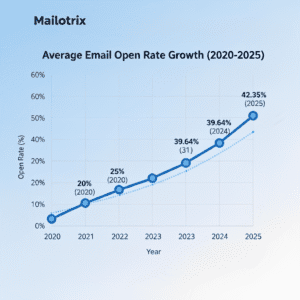
20.4% — Global average email open rate in 2020 (Mailchimp + Campaign Monitor + GetResponse).
35%–42% — Global average open rate in 2025, depending on platform.
42.35% — MailerLite currently reports the highest average open rate.
35.63% — Mailchimp’s latest average open rate.
39.64% — GetResponse’s 2024 average open rate.
Open rates have nearly doubled since 2020 across most industries.
Email open rates have experienced a massive shift over the past five years. Back in 2020, the global average sat at 20.4%, which most marketers considered “normal.” Fast-forward to 2025, and the average ranges from 35% to 42%—almost double what we saw just a few years ago.
Platforms like MailerLite lead the pack with 42.35%, followed by GetResponse at 39.64%, and Mailchimp trailing slightly at 35.63%. This jump isn’t random—it reflects better segmentation, cleaner lists, higher deliverability standards, and smarter optimization by marketers.
In short, the inbox hasn’t become easier… marketers have become better. Today’s open rates reward strategy, relevance, and trust—showing that thoughtful email marketing can deliver stronger results than ever before.
Segmentation & Open Rates
14.31%–30% higher open rates for segmented campaigns compared to non-segmented emails.
78% of marketers say segmentation is the most effective way to improve performance.
14.31% lift from purchase-history segmentation and 17% higher open rates in B2B segmentation.
Behavior-based emails hit up to 42.36% open rates, while generic broadcasts stay around 14.5%–26.9%.
These numbers are strong for a reason. When segmentation boosts open rates by 14.31% to 30%, (Mailchimp) it’s basically proving that relevance decides whether someone clicks or ignores your email. People simply respond better when the message matches what they care about.
The fact that 78% of marketers call segmentation their most effective strategy says a lot. (Hubspot)With so many tactics available — automations, subject lines, send-time optimization — segmentation still comes out on top because it directly impacts attention.
Even niche segments deliver results. Purchase-history targeting gives you a 14.31% lift, (Mailchimp) and B2B segmentation adds 17% more opens. That’s your audience telling you, “Talk to me about what matters to me.”
And behavior-based segmentation? That’s the real winner. Hitting 42.36% open rates compared to broadcast emails stuck around 14.5%–26.9% shows how powerful it is when your email reflects someone’s recent action — a browse, a click, a purchase, or even a cart visit.
In simple terms: segmentation works because your email stops feeling random and starts feeling personal. That’s why the stats consistently lean in its favor. (Fluent CRM)
Valuable, Journey-Based Content
42.36% open rates for behavior-based emails vs 14.5%–26.9% for generic broadcasts.
Unsubscribe rates can hit 6.4% for broadcast emails but drop to 0.15% when content matches the subscriber’s journey.
Behavior-based emails can generate a 60.7× increase in conversions compared to generic emails.
Behavior-based emails pull far ahead because they speak to what someone is actually doing. When you go from random broadcasts to content tied to a user’s journey, open rates climb from 14.5%—26.9% all the way to 42.36%. People pay attention when the message feels relevant. (Omnisend)
Relevance also protects your list. Broadcast emails can trigger unsubscribe rates of 6.4%, (MoEngage)simply because people get tired of seeing the same generic messaging. But when your content follows their behavior, unsubscribes drop to 0.15%. That’s the power of sending something they actually want.
And the biggest win? Conversions. Journey-based content isn’t just engaging — it performs. In retail and e-commerce, behavior-based emails can drive a 60.7× jump in conversions compared to generic blasts.
In simple terms: when your content matches where someone is in their journey, everything improves — opens, engagement, retention, and sales.
Personalized Subject Lines
Personalized subject lines can boost open rates by 22% to 50%.
Adding the subscriber’s first name increases opens by around 26%.
Advanced personalization (interests, behaviors, company names) can lift open rates by 26%.
47% of people open an email just because of the subject line.
Personalization works because it instantly feels relevant. When open rates jump 22% to 50% with personalized subject lines, it’s a clear sign that people pay attention when the message looks like it was written for them — not blasted to everyone.
Even simple tweaks matter. Using a subscriber’s first name can boost opens by 26%, which shows how small personal cues can create a big emotional pull.
But deeper personalization performs even better. When your subject line references someone’s interests, recent behavior, or even their company name, you can add another 26% lift — because now the email speaks directly to what they care about.
And with 47% of people deciding to open an email based purely on the subject line, personalization becomes one of the easiest high-impact wins in email marketing.
In simple terms: the more personal the subject line feels, the more likely it is to get opened (Mailoptin)
Open Rates by Industry (2024–2025)
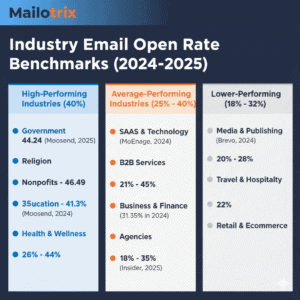
Government leads with 46.94% average open rates.
Nonprofits range from 40.04% to 46.49%, one of the strongest sectors.
Religion sees 44.24% open rates on average.
Education hits 35.64% to 41.33%, depending on the source.
Health & Wellness ranges widely from 26% to 44%.
SaaS & Technology reaches up to 44.72%.
B2B Services fall between 21% to 45%.
Business & Finance averages 27% to 35%.
Agencies sit between 18% to 35%.
Media & Publishing ranges 20% to 39.89%.
Retail & eCommerce stays lower at 18% to 32%.
Travel & Hospitality averages 22% to 28%.
Email open rates don’t follow one universal benchmark — they swing wildly depending on the industry. A nonprofit can easily pull 40%+ open rates, but an eCommerce store might struggle to break 25%. That’s why comparing yourself to your own industry is far more accurate than looking at global averages.
A big reason for the wide spread is audience intent. Industries like government, religion, nonprofits, and education naturally attract highly engaged subscribers — which is why they post 40–46% open rates consistently. In contrast, eCommerce and travel deal with promo-heavy inboxes, so 18–32% is normal.
Apple’s Mail Privacy Protection (MPP) also inflated opens in certain sectors, especially B2C-heavy ones. So a 44% open rate in SaaS or health isn’t unusual anymore — but it doesn’t automatically mean subscribers are more interested. Context matters. (Brevo, 2025) (Mailchimp)
Preheader Text & Engagement
Custom preheaders can push open rates to 44.67%, compared to 39.28% without one.
24% of subscribers read the preview text before deciding to open.
Optimized preheaders can drive up to a 104% increase in clicks in A/B tests.
Preheaders matter because they give you a second chance to win the open. When using a custom preheader lifts open rates from 39.28% to 44.67%, (GetResponse ) that extra five-point jump shows how much the preview text influences first impressions.
Subscriber behavior backs this up. With 24% of people actively checking the preview text before opening, ( Litmus) your preheader becomes just as important as your subject line. It’s the “why you should open” line most marketers ignore.
The real magic shows up in clicks. A/B tests revealing a 104% increase in clicks from optimized preheaders prove that this tiny line of text doesn’t just get emails opened — it motivates action inside the email too.
In simple terms: a strong preheader amplifies your subject line, clarifies the value, and pushes people to engage. This is one of the smallest tweaks with one of the biggest payoffs.
Sender Name & Trust
42%–68% of people say the sender name is the first or most important thing they check before opening an email.
In a major survey: 78% open emails because of the sender, while only 22% open based on the subject line.
94.5% of subscribers say recognizing the brand or sender is “very important.”
Switching from a generic sender (e.g., hello@voices.com) to a real person (Silvana Cordoba) increased welcome email opens from 28.75% to 43.63%.
Sender identity matters more than marketers think. When 42%–68% of subscribers say the sender name is their first filter, (Brevo)it’s clear people open emails based on who is talking to them — not just what the subject line says.
The survey numbers back this up. If 78% of people open emails because they trust the sender and only 22% rely on the subject line, sender recognition becomes your biggest lever for improving open rates. (Mailjet)
Trust plays a huge role here. With 94.5% of subscribers calling brand recognition “very important,” a consistent, human sender name instantly feels safer. Generic addresses like “info@” or “noreply” get ignored — or deleted — because they signal low value.
And the impact is real. Just switching from a brand-level email to a real person boosted welcome sequence opens from 28.75% to 43.63%. That’s a simple change delivering a major lift.
In simple terms: people open emails from people they trust. Make your sender name human, consistent, and recognizable — and your open rates will climb. (Moosend)
Best Days to Send Emails
Tuesday is consistently ranked as the best day for open rates across multiple industries.
Wednesday and Thursday also perform strongly for opens and conversions.
Midweek sends see the highest engagement because people are settled into their routine.
Saturday typically delivers the lowest open rates overall.
Midweek wins because it fits how people actually behave. By Tuesday, subscribers are fully back into their work rhythm — not overwhelmed like Monday, and not distracted like Friday. That’s why Tuesday shows up again and again as the strongest day for open rates.
Wednesday and Thursday follow close behind. Engagement stays high because inboxes are calmer, and people are more likely to check emails with intention — which leads to better opens and more conversions.
On the other hand, Saturday is usually a bad bet. Open rates drop hard because people disconnect, spend time offline, and ignore anything that feels like work.
In simple terms: send midweek when attention is highest, and avoid weekends where engagement dips.
Best Times of Day to Send Emails
9:00 AM – 11:00 AM (local time) is the strongest window as people settle into their workday and check their inbox.
1:00 PM – 3:00 PM gives you a second peak when subscribers return from lunch and clear pending emails.
5:00 PM – 7:00 PM performs well for B2C, especially on mobile, as people wind down and browse personal emails.
Timing works when it matches real human habits. The 9–11 AM slot performs best because most people start their day by checking emails alongside their morning coffee. Your message lands right when their inbox has their full attention.
The early afternoon window (1–3 PM) creates another sweet spot. After lunch, people usually catch up on missed notifications — which puts your email right in the decision zone.
For B2C brands, 5–7 PM shines. As people wrap up their day and switch to personal mode, they scroll email on their phones. That’s why consumer-focused campaigns see strong open rates in the early evening.
In simple terms: follow the natural rhythm of your audience — mornings for work focus, afternoons for catch-up, and evenings for casual browsing.
Email Timing & User Behavior
58% of adults check their email first thing in the morning.
21% of emails get opened within the first hour of landing in the inbox.
55%+ of email opens happen on mobile, with spikes in early morning and evening commutes.
B2B performs best during 9 AM–5 PM, while B2C sees stronger results in evenings or weekends.
Most people start their day with their inbox. When 58% of adults check email first thing in the morning, sending early puts your message right at the top of their daily routine — before the inbox gets crowded.
Timing also matters because of how quickly people open new emails. With 21% of opens happening in the first hour, your delivery time directly affects visibility. Show up at the wrong time, and you get buried.
Mobile behavior changes the game too. Since 55%+ of opens happen on mobile, and those opens spike during mornings and evening commutes, sending when people are already scrolling gives you an instant advantage.
Industry behavior adds another layer. B2B emails win during standard work hours (9–5) when professionals are at their desk. Meanwhile, B2C campaigns often perform better in the evenings or weekends, when people switch to personal browsing.
In simple terms: match your send time to how — and when — your audience lives their day. That alone can boost opens without changing a single word in your email. (WebFX)
B2B vs B2C Open Rates (2025)
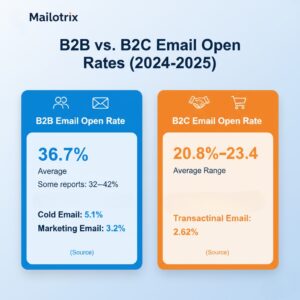
B2B open rate: ~36.7% (range 32%–42%)
B2C open rate:20.8%–23.4%
B2B cold email CTR:5.1%
B2B marketing CTR:3.2%
B2C CTR:2.62%
B2B email ROI:$46 per $1 spent
B2C: remains the top ROI channel for fast consumer conversions
B2B conversion rate:2.4%
B2C conversion rate:2.8% (Retail & Fashion up to 3.3%)
B2B personalized subject lines:+30% reply rate
B2C personalization:+22% revenue boost
77% of B2B buyers prefer email for updates
59% of B2C consumers say email influences purchases
B2B vs B2C Email open rate
B2B and B2C email performance isn’t even close — and that’s because the audiences behave very differently. B2B emails naturally get higher opens (around 36.7%) because professionals rely on email as their main communication channel. Compare that to B2C where open rates sit closer to 21–23%, simply because consumer inboxes are flooded with promos.
CTR shows the gap even more clearly. B2B cold outreach pulls a strong 5.1% CTR, while B2C sits around 2.62%. This matters because clicks are a far better indicator of engagement than opens — especially after Apple MPP inflated open metrics for everyone.
Conversions follow a similar pattern. B2C converts slightly higher at 2.8%, thanks to impulse buying, retail offers, and fast-moving behavior. B2B sits at 2.4%, which is still strong considering longer decision cycles and multiple stakeholders.
Personalization works for both. In B2B, personalized subject lines can boost replies by 30%. In B2C, personalized offers and product recommendations can increase revenue by 22%. Different goals, same outcome: relevance wins.
Open Rates by Business Model (2025)
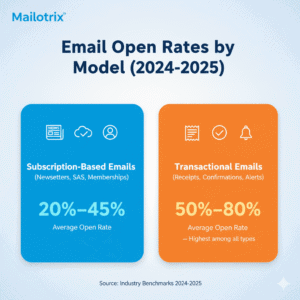
Subscription-based emails:20%–45%
Top-performing newsletters often surpass 40%+ open rates
Transactional emails:50%–80%
Post-purchase transactional emails get up to 217% higher opens than promotional emails
Welcome emails: can exceed 83% open rates
Open Rates by Business Model
Email performance isn’t just about industry — your business model plays a major role too. Subscription-based newsletters usually see 20–45% open rates because subscribers join specifically for content. The best newsletters consistently cross 40%, showing how deeply engaged their readers are.
Transactional emails, however, are in a league of their own. These include order confirmations, password resets, receipts, shipping updates — and they regularly hit 50–80% open rates. Why? Because people expect them and they contain essential information. In fact, post-purchase emails can generate up to 217% higher opens compared to standard promotional campaigns.
Welcome emails perform even better. Since subscribers open them immediately after signing up—and engagement is at its peak—these messages can exceed 83% open rates.
BIMI logos can increase open rates by 10% to 20%+, with some studies showing 21%–39% lifts.
An investment firm using BIMI saw a 6% increase in opens, while a competitor without BIMI saw a 10% decline.
Consistent visual branding through BIMI can boost brand recall by 18%.
BIMI can influence the full funnel, increasing purchase likelihood by up to 34%.
BIMI works because it makes your email instantly recognizable. When open rates jump 10% to 20%+, and in some tests even 21%–39%, it proves that a simple verified logo beside your sender name can change how people react to your message.
Real-world data backs it up. One investment firm saw a 6% lift in opens after adopting BIMI, while a competitor that didn’t use BIMI actually saw a 10% drop. That’s the advantage of showing up with trust signals your competitors lack.
Brand recall is another win. With BIMI improving recognition by 18%, your emails become easier to spot in crowded inboxes — which leads to more opens over time, not just in one campaign.
And it doesn’t stop at opens. The visual trust from BIMI can lift purchase likelihood by 34%, proving that stronger brand credibility impacts the entire funnel.
In simple terms: BIMI makes your emails look verified, trustworthy, and professional — which means more opens, more engagement, and more revenue. (Valimail)
Inbox Placement & Spam Complaints
Average inbox placement rates across industries sit around 85%–89%, meaning a big chunk of emails still land in spam or Promotions tabs.
Emails that miss the primary inbox have near-zero open rates.
Spam complaint thresholds are extremely strict — going above 0.1% (1 complaint per 1,000 emails) can hurt your sender reputation.
Landing in the inbox is half the battle. When inbox placement averages hover around 85%–89%, it means 10–15% of emails never even get a chance to be opened. Anything that falls into spam or a secondary tab basically disappears — which is why missing the primary inbox kills open rates instantly.
Spam complaints make this even trickier. Providers like Gmail watch complaint rates closely, and going above 0.1% is a major red flag. Just a single complaint per thousand emails is enough to damage your reputation.
Once mailbox providers see complaints rising, filters tighten fast. Your emails start getting pushed into spam, and recovery becomes harder with every send.
In simple terms: good inbox placement is non-negotiable — because even the best subject line can’t save an email that never reaches the inbox.
Clean Email Lists & Deliverability
A clean email list can boost open rates by 5%–15% by targeting genuinely interested recipients.
Emails from senders with a strong reputation are 50% more likely to reach the inbox than those with a poor score.
Keeping bounce rates under 0.5% is ideal; exceeding 2% signals deliverability issues.
Cleaning your email list pays off fast. When open rates increase by 5%–15%, it’s because every email lands in the hands of someone who actually wants to read it. No more wasting sends on invalid or uninterested addresses.
Sender reputation also drives results. Emails from high-reputation senders are 50% more likely to hit the inbox, meaning your carefully crafted campaigns actually get seen. A poor reputation, on the other hand, can bury your messages before they’re ever opened.
Bounce rates are the early warning system. Removing invalid addresses keeps your bounce rate below 0.5%, protecting deliverability. Go over 2%, and inbox providers start flagging you — which hurts future sends.
In simple terms: a clean, verified list ensures your emails land, get opened, and maintain your sender credibility.
Re-engagement & Win-Back Campaigns
Resending campaigns to non-openers can boost overall open rates by 10%–30%, with some cases seeing up to 54.7% lift.
Dedicated re-engagement emails often achieve 36%–42.51% open rates, compared to 14.5%–26.9% for general broadcasts.
Personalization (name, purchase history) can increase re-engagement open rates from 18% to 31%.
45% of recipients who open a re-engagement email will continue reading future emails.
Re-engagement campaigns are a powerful way to wake up dormant subscribers. Simply resending an email to non-openers can add 10%–30% more opens, and in some tests, lift rates as high as 54.7%. It’s a second chance that’s often overlooked.
These campaigns outperform generic broadcasts. With open rates around 36%–42.51%, they almost double the average 14.5%–26.9% seen in standard sends. The secret? Targeted messaging and relevance.
Personalization boosts results even further. Using a subscriber’s name or referencing their purchase history can push opens from 18% to 31%, proving that people respond when the message feels tailored.
Re-engagement also has long-term benefits. Around 45% of people who open a re-engagement email continue to engage with your next emails, showing renewed interest and keeping your list active.
In simple terms: don’t give up on inactive subscribers. A well-timed, personalized re-engagement email can revive opens, clicks, and long-term engagement.
Mobile Email Optimization
50%–70%+ of email opens happen on mobile devices, making mobile-first design essential.
80% of people delete emails that don’t display or function properly on mobile.
Responsive templates can increase unique mobile clicks by up to 15%, boosting overall engagement and future opens.
Mobile dominates email consumption. When 50%–70% of opens happen on phones or tablets, ignoring mobile design means ignoring the majority of your audience.
Display issues are costly. 80% of people will delete an email immediately if it doesn’t render properly on mobile. That’s an instant lost open and a wasted send.
Using responsive templates fixes this. By adapting to any screen, you can boost unique mobile clicks by up to 15%. More clicks mean higher engagement, and higher engagement drives more opens in future campaigns.
In simple terms: if your emails aren’t mobile-friendly, you’re leaving opens and engagement on the table. Make them responsive, and your messages get seen, read, and acted on.
A/B Testing & Email Performance
Emails that undergo A/B testing can see 49% higher open rates than untested campaigns.
Testing subject lines alone can increase opens by an average of 42%, with optimized lines 22%–50% more likely to be opened.
Systematic A/B testing can drive broader results — one fashion retailer saw a 30.9% revenue per email increase by testing consistently.
A/B testing works because it lets you figure out what actually resonates. When testing can lift open rates by 49%, ignoring it means leaving nearly half of your potential engagement on the table.
Subject lines are the low-hanging fruit. Testing these alone can boost opens by 42%, and the best-performing lines are 22%–50% more likely to get clicked. That first impression drives the rest of the campaign’s success.
The real power comes with consistency. Systematic testing builds a knowledge base about your audience — what they like, what grabs attention, and what motivates clicks. One retailer turned this into a 30.9% lift in revenue per email, starting with open-rate improvements.
In simple terms: test everything you can, especially subject lines. Each small insight compounds over time, leading to more opens, more clicks, and more revenue.
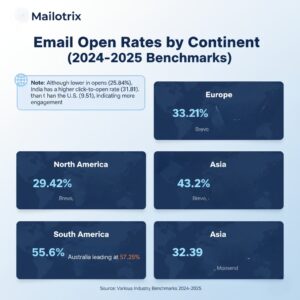
🌍 Email Open Rates by Country and Continent (2025)
Email open rates vary massively around the world — and that’s why understanding where your audience is matters more than ever. Data from GetResponse’s Email Marketing Benchmarks (2024) and Brevo’s 2025 Industry Report show that location impacts engagement, deliverability, and even how people interact with your brand’s emails.
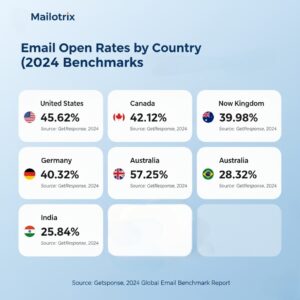
📬 Open Rates by Country (2024 Benchmarks — GetResponse)
🧠 Interesting Insight: Even though India’s open rate (25.84%) is much lower than the U.S. (45.62%), India actually has a higher click-to-open rate (31.81% vs 9.51%), meaning fewer opens, but more meaningful engagement.
Average Spam Filtering: Around 10.5% of emails — even legitimate ones — end up in spam folders.
Inbox Placement Rates: Global inbox placement averages 83.1%–85%, meaning 15–17% of emails never reach the primary inbox.
Human Behavior Impact:80% of users say they mark emails as spam simply because the message “looks like spam” — messy formatting, scammy words, or poor design can trigger human-driven filtering.
Even if your intentions are clean, the inbox battlefield is tough. On average, 1 in every 10 emails gets pushed straight into spam — not because you’re doing something wrong, but because email providers aggressively protect users.
With inbox placement sitting at 83%–85%, a big portion of your hard-worked campaigns never even get a chance to be opened. And the surprising part? It’s not just algorithms deciding your fate.
A huge 80% of people manually mark emails as spam if the content “looks spammy” — meaning ugly formatting, exaggerated claims, or desperate language (“Act now!!”, “100% FREE!!!”). And once they mark it, mailbox providers learn to bury future emails automatically.
The lesson: How your email looks and feels directly affects whether it ever reaches the inbox. Clean design, honest language, and trustworthy branding are your best defense against spam placement.
🌍 Language and Cultural Nuances in Email Engagement (2025)
Key Stats That Prove Localization Matters
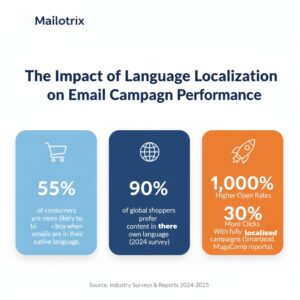
55% of consumers are more likely to buy when emails are written in their native language (Smartlead).
90% of global shoppers prefer content in their own language (Smartlead, 2024).
90% of new Indian internet users prefer Indic-language content (MailerLite, 2020).
Fully localized email campaigns can achieve up to 1,000% higher open rates (Smartlead, MageComp).
Localized emails generate up to 30% more clicks compared to non-localized messages (Smartlead, MageComp).
Email marketing is no longer just about sending the right message — it’s about speaking the right language and understanding cultural context
Data from 2025 clearly shows that localization plays a massive role in boosting open rates, click-throughs, and conversions. Simply translating an email isn’t enough anymore — brands that adapt their tone, visuals, and style to fit local cultures see far better results. (Sources: VoilaNorbert, ResearchGate)
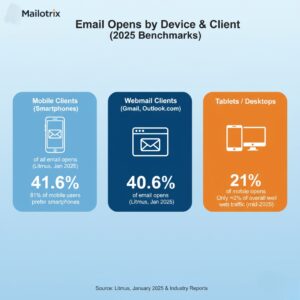
41.6% of all email opens happen on mobile devices (Litmus, 2025)
81% of users prefer checking email on smartphones (Campaign Monitor, 2025)
Webmail accounts for 40.6% of all email opens — mainly accessed via mobile browsers (Litmus, 2025)
Desktop accounts for only 16.2% of opens — a steady decline (Litmus, 2025)
Desktop users consistently show higher click-through rates than mobile users (Litmus, 2025)
Tablets make up just 21% of all “mobile” opens (Campaign Monitor, 2025)
Tablets now represent only ~2% of total web traffic (Campaign Monitor, 2025)
Mobile continues to dominate email engagement — and the numbers leave no debate.
41.6% of email opens come from mobile clients, making it the #1 email reading environment.
Smartphones are the preferred device for 81% of people, especially younger audiences who check email while commuting, scrolling, or multitasking.
This shift is strongest among Gen Z and Millennials, who rely heavily on phones for all online communication — forcing brands to prioritize short subject lines, scannable layouts, and mobile-optimized CTAs.
Most users now check their emails on their phones, with desktop use dropping year by year.
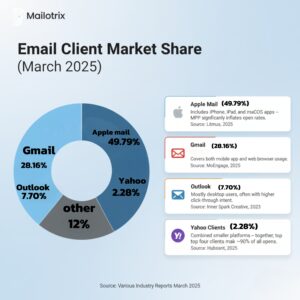
Apple Mail holds 49.79% of all email opens (Litmus, 2025).
Gmail holds 28.16% market share (MoEngage, 2025).
Outlook accounts for 7.70% of opens (Inner Spark Creative, 2025).
Yahoo Mail has 2.28% share (Omnisend, 2025).
Top four clients together make up ~90% of all opens (HubSpot, 2025).
Apple MPP can inflate open rates by up to 2× (Omeda, 2025).
Gmail “Updates” tab read rate is 28%; “Promotions” tab read rate is 19.2% (Blueshift, 2025).
Outlook users show higher desktop CTR despite smaller market share (Inner Spark Creative, 2025).
Email clients have a huge influence on your open rates — sometimes more than your subject line itself. With Apple Mail controlling nearly half of all global opens, Apple’s MPP privacy feature can inflate opens by up to 2×. That’s why many marketers shifted their focus from open rate to CTR and CTOR, which reflect real user engagement.
Gmail brings its own challenges. Whether your email lands in the Updates tab (28% read rate) or the Promotions tab (19.2%) can completely change how many people see it. Yet Gmail remains the top choice for both personal and professional users, so optimizing for Gmail’s filtering logic is crucial.
Outlook’s share may be smaller, but desktop users tend to click more often — making Outlook especially valuable for B2B audiences.
Overall, the numbers make one thing clear: understanding how each email client behaves helps you interpret your open rates accurately and optimize your campaigns for where your audience actually reads emails.
When it comes to where your subscribers read emails in 2025, Apple Mail and Gmail completely dominate.
However, Apple’s Mail Privacy Protection (MPP) has made tracking open rates trickier — forcing marketers to rely more on CTR (Click-Through Rate) and CTOR (Click-to-Open Rate) for real engagement insights.
82.7% of OS users prefer dark mode across devices (Litmus, 2025).
36% of marketers were already testing dark-mode email designs (Email on Acid, 2021).
Dark mode emails saw 17% longer time on page in A/B tests (Thinkster).
Bounce rates dropped by 21% for dark-mode emails in the same test (Thinkster).
CTR improved by 11% when dark-mode emails were well-optimized (Thinkster).
Some studies show light mode users spend more time reading emails (Publicare).
Dark mode reduces eye strain in low-light environments (Publicare).
Light mode performs better for longer reading sessions and detailed text (Publicare).
Dark mode is no longer just a visual preference — it affects engagement. With 82.7% of OS users preferring dark mode, ignoring it can mean missing a huge chunk of your audience.
Testing shows clear benefits. Dark-mode emails increased time on page by 17%, reduced bounce rates by 21%, and improved CTR by 11% when optimized. That’s real, measurable impact on engagement.
However, it’s not one-size-fits-all. Light mode still works better for longer reading sessions and content-heavy emails, while dark mode shines in low-light environments and short, attention-grabbing messages.
In simple terms: design for your audience and context. Offering dark-mode-friendly emails keeps users comfortable, engaged, and more likely to interact with your content. (Thinkster + Publicare)
Tweaks, Massive Lifts — That’s the Real Power of Email Optimization
When you look at the numbers, one thing becomes clear: email opens don’t improve by accident. They improve because of intentional, data-backed decisions. Whether it’s a personalized subject line, smarter segmentation, optimized send times, or a simple A/B test—each adjustment gives your emails a measurable advantage.
And when these optimizations stack, the impact compounds. Higher inbox placement → more opens. Better relevance → fewer unsubscribes. Stronger trust → consistent long-term engagement.
You’re not just fighting for attention in a crowded inbox—you’re shaping how subscribers feel about your brand. Add a human tone, a clean list, helpful content, and yes, even humor… and suddenly your emails become the ones people enjoy opening.
At the end of the day, improving open rates isn’t about one magic trick; it’s about combining dozens of small, smart, strategic moves. Together, they turn average emails into high-performing campaigns that get opened, clicked, and remembered.
Your inbox performance is in your control—you just have to apply the right levers. Let the data guide you, keep testing, stay human, and your open rates will steadily climb.
Kartik Sharma – Founder of Mailotrix & Email Marketing Strategist
Kartik Sharma is the driving force behind Mailotrix and the mind behind its Email Marketing Strategy Desk. With years of experience running profitable campaigns for his own projects and clients, Kartik knows exactly what works (and what just fills up spam folders).
At Mailotrix, Kartik shares actionable email marketing tips, guides, and strategies that help business owners grow their lists, boost open rates, and turn subscribers into loyal customers. His approach is simple: no jargon, no “guru tricks” — just proven methods tested in real campaigns.
When he’s not breaking down email tactics, you’ll find Kartik exploring new ways to make email fun, effective, and less of a chore for busy entrepreneurs. His writing blends expertise with real-world results, making him a go-to source for anyone who wants to actually win the inbox.