
Last Updated: 03 Jan 2026
If you think clicks are just a “nice bonus” after opens, think again.
In 2026, email clicks are the real performance signal. Opens may tell you who noticed your email — but clicks tell you who actually cared. With shrinking attention spans, mobile-first inboxes, and AI-driven filtering, getting someone to click has become harder — and more valuable — than ever.
That’s why we analyzed the latest Email Click-Through Rate (CTR) & Engagement Statistics (2025–2026) to uncover what actually drives clicks today — from CTA clarity and subject lines to automation, personalization, and mobile behavior.
This data-backed breakdown will show you:
What a “good” email CTR really looks like in 2025
Which strategies consistently outperform broadcast campaigns
How CTAs, urgency, visuals, and timing influence click behavior
Why segmentation, automation, and AI are now click multipliers
And exactly what to optimize if your emails are getting opened but not clicked
Whether you run an eCommerce store, SaaS product, newsletter, or outbound sales funnel, these insights will help you turn passive readers into active clickers — and clicks into revenue.
So before you tweak another subject line or resend a campaign, take a few minutes to go through the stats below. You’ll walk away with clear benchmarks, proven patterns, and actionable takeaways to increase your email clicks — and ROI — in 2025 and beyond.
Table of Contents
ToggleHow We Collected These Email List Building Stats
At Mailotrix, we carefully curated these email list building statistics from trusted and verified industry sources such as HubSpot, Statista, Campaign Monitor, GetResponse, Bluecore, and WebFX, along with the latest 2023–2026 reports and research studies.
Every stat included here was selected based on:
✅ Credibility — We only use data from reputable, verifiable sources.
✅ Relevance — Each stat directly supports email marketers, business owners, and creators who want to grow their lists.
✅ Recency — We focus on the latest available data to reflect current trends and results.
All statistics were cross-verified across multiple sources to ensure accuracy and consistency.
This page is regularly updated to keep the information fresh and relevant for marketers like you.
Email Click-Through Rate (CTR) — TL;DR Key Stats
Call-to-Action (CTA) Strategy & Click Behavior
Clicks happen when the decision is easy.
Emails with one clear CTA get 371% more clicks than those with multiple actions.
Outbound sales emails see up to 1,617% higher sales with a single CTA.
CTA buttons outperform text links by 28% in conversions.
First-person CTAs (“Get my free trial”) drive 90% more clicks than generic copy.
Subject Lines, Urgency & Preview Text
Clicks start before the open.
Time-based urgency (“Ends tonight”) increases CTR by 22%.
Using “you / your” in subject lines lifts CTR by ~11%.
Subject line + preview text working as one idea increases CTR by 7%.
Automated & Behavior-Based Performance
Timing beats scheduling.
Behavior-triggered emails get 332% higher CTR than standard newsletters.
Abandoned cart emails: 21%–23.33% CTR (highest intent).
Welcome emails: 5× more clicks than regular campaigns.
Back-in-stock alerts: 59.19% average open rates with strong click intent.
Segmentation & Personalization
Relevance multiplies clicks.
Segmented campaigns see 100.95% higher CTR than non-segmented sends.
Some brands report 760% revenue growth after switching to segmentation.
AI-personalized content increases CTR by 13.44%.
Product recommendations boost CTR by 25%–30%.
Visuals & Interactive Elements
People scan — visuals do the selling.
Emails with images get 42% higher CTR than text-only emails.
Interactive elements drive 73% higher click engagement.
In-email surveys increase responses by 52% by removing extra steps.
Mobile Optimization & CTA Placement
Design decides clicks in seconds.
70%+ users delete emails within 3 seconds if mobile design is poor.
40%+ abandon if value isn’t clear in the first 3 seconds.
Buttons sized 44×44 px increase CTR by 15%.
CTAs placed above the fold avoid a 70% visibility drop.
Aligning CTAs with the “F-pattern” boosts clicks by 25%.
Global Average Email CTR (2026)
Email click rates are going up
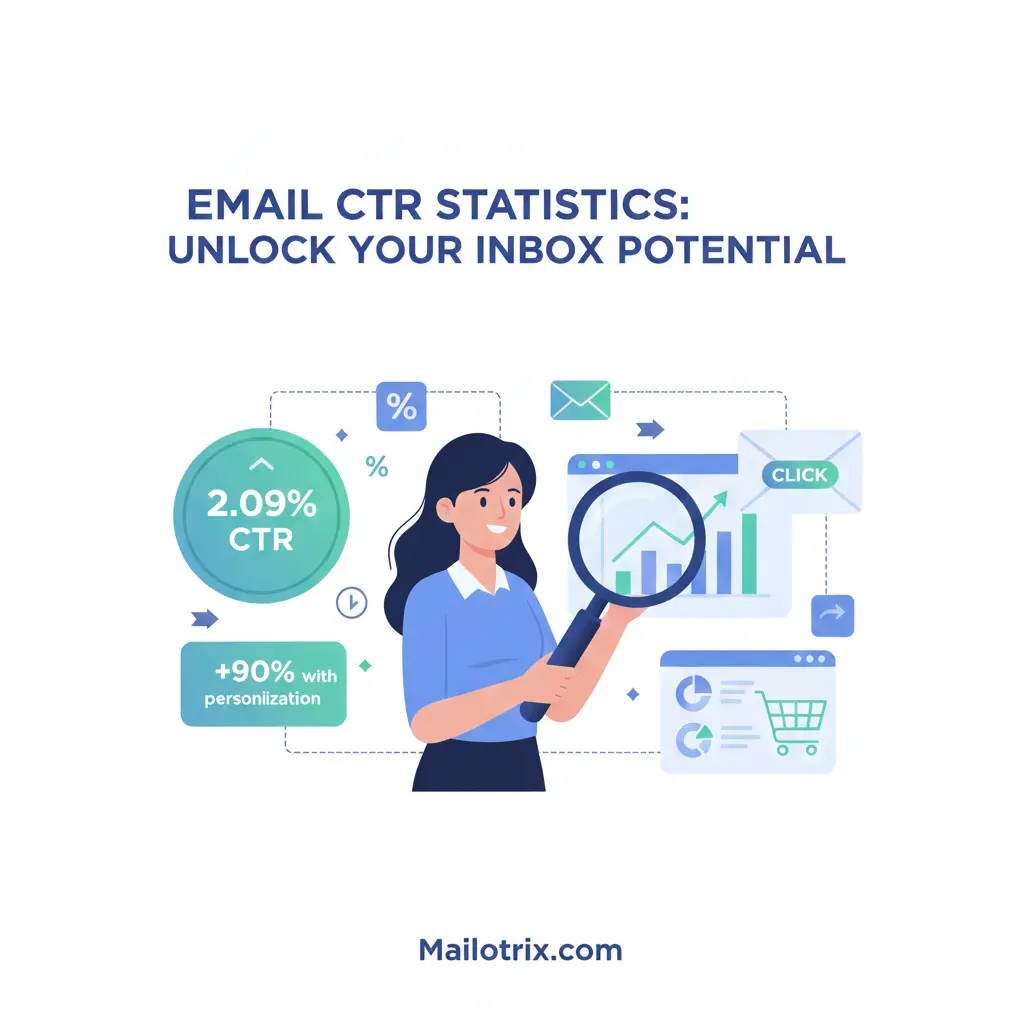
In 2025, the average email Click-Through Rate (CTR) worldwide is about 2.09%.
This is a small increase from 2.0% in 2024, showing steady improvement year after year.
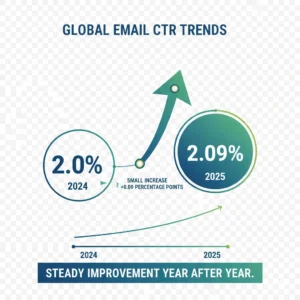
This change may look small, but it matters. Click rates usually improve little by little, not all at once. Even a small rise means more emails are getting clicks because messages are becoming more useful and better matched to what people want.
A 2.09% average also shows something important: most emails still don’t get clicked. That’s why reaching a 3%–4% click rate puts you ahead of many other senders.
In simple terms: the average is improving, but higher clicks still come from sending the right message to the right people — not from sending more emails.
Call-to-Action (CTA) Strategy & Click Behavior
Marketers get 371% more clicks when an email focuses on one clear CTA instead of multiple actions.
Outbound sales emails see up to 1,617% higher sales when only one CTA is used.
CTA buttons increase conversions by 28% compared to plain text links.
First-person CTA copy drives 90% more clicks, simply by saying “Get my free trial” instead of “Get your free trial.”
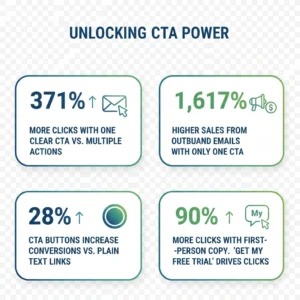
These numbers are strong for a reason. When a single CTA drives 371% more clicks, it clearly shows that clarity beats choice. When readers see multiple buttons or links, they pause, think, and often do nothing. One clear action removes hesitation. (Source)
The 1,617% sales lift in outbound emails proves this even further. Sales emails work best when the reader knows exactly what to do next. A single CTA keeps the focus on one outcome instead of splitting attention. (Source)
Buttons outperform text links by 28% because they are visually obvious and tap-friendly, especially on mobile. A button looks like an action, while a text link often gets skipped during scanning.
First-person language delivers a 90% click boost because it creates psychological ownership. “Get my free trial” feels personal and immediate, while “Get your free trial” feels generic and distant.
In simple terms: clicks happen when the decision is easy. One clear CTA, shown as a button, written in first-person language removes friction—and the stats consistently prove it.
Subject Lines, Urgency & Preview Text (Click Behavior)
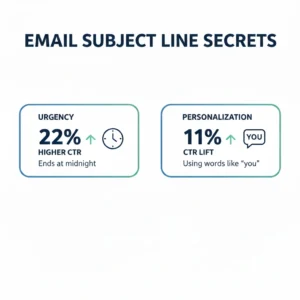
22% Higher CTR: Subject lines with real time pressure like “Ends at midnight” drive 22% more clicks. (Source)
11% CTR Lift: Using direct words like “you” or “your” increases clicks by around 11%. (Source)
7% More Clicks: When the subject line and preview text work together as one message, CTR improves by 7%.
These stats work because clicks start before the email is opened.
Real urgency pushes action. When people see a clear deadline, it triggers FOMO, so they’re more likely to open and click now, not later.
Direct language feels personal. Words like “you” and “your” make the email feel written for one person, not a list — and personal emails always get more attention.
The subject line + preview text combo matters because inbox scanning is fast. When both lines complete the same idea, the message is instantly clear, reducing confusion and increasing curiosity. (Litmus)
In simple terms:
If your subject line creates urgency, speaks directly to the reader, and your preview text supports it — the click becomes a natural next step.
Automated & Behavior-Based Performance
332% Higher Clicks: Behavior-based emails get 3.3× more clicks than regular scheduled newsletters.
21%–23.33% CTR: Abandoned cart emails get the highest clicks because intent is already high.
5× More Clicks: Welcome emails outperform normal campaigns by a huge margin. (Source)
59.19% Open Rates: Back-in-stock emails drive massive engagement because demand already exists.
Why these stats work
These numbers are strong because behavior-based emails arrive at the right moment, not a random time. When someone abandons a cart, opens an account, or waits for a product to return, their interest is already high — the email simply nudges them to act.
A 332% click boost proves that timing beats bulk sending. Welcome emails work because attention is highest right after signup. Abandoned cart emails win because the buyer is already close to purchasing. Back-in-stock emails succeed because they remove the one blocker stopping the sale. (Source)
In simple terms: automation works because it reacts to intent, not guesses it. That’s why automated emails consistently crush broadcast campaigns.
Segmentation & Personalization (CTR Impact)
100.95% Higher CTR: Segmented email campaigns get nearly double the clicks compared to non-segmented lists.
760% Revenue Increase: Marketers report up to 7.6× more revenue after switching from bulk emails to segmented messaging.
13.44% CTR Lift: Emails that use AI-personalized content (not just the name) see higher engagement.
25%–30% More Clicks: Product recommendations based on past purchases significantly boost CTR.
These numbers are strong because relevance drives action. When CTR jumps by 100.95%, it clearly shows that people click more when emails feel made for them, not for everyone. Segmentation turns your email from a broadcast into a conversation. (Source)
That 760% revenue increase happens because segmented emails don’t just get more clicks — they attract better clicks. Readers see offers that actually match their needs, which naturally leads to more conversions and higher order value.
AI personalization takes this further. A 13.44% CTR lift proves that users respond when the entire message feels tailored — content, offers, and tone — not just their first name in the subject line.
And product recommendations work because they remove thinking. When you show products based on past behavior, CTR rises 25%–30% simply because users don’t have to search — the right option is already in front of them. (Source)
In simple terms: segmentation and personalization win because your email stops feeling generic and starts feeling useful. That’s why clicks, conversions, and revenue all rise together.
Visuals & Interactive Elements
42% Higher CTR: Emails with clear, well-placed images get 42% more clicks than plain text emails.
73% More Engagement: Adding interactive elements (like sliders or hover effects) increases click engagement by up to 73%.
52% Higher Responses: In-email surveys get 52% more responses than surveys sent to landing pages.
Why these stats work
These numbers make sense because people don’t read emails — they scan them. Images help the brain understand the message faster than text alone. When someone instantly “gets it,” they’re more likely to click.
Interactivity works because it turns the email from a passive message into an action. The moment a user swipes, taps, or interacts, their attention goes up — and attention leads to clicks.
In-email surveys remove friction. Instead of clicking a link, waiting for a page to load, and then responding, the user can act instantly. Fewer steps = more responses.
In simple terms: visuals grab attention, interaction keeps it, and ease of action converts it. That’s why these stats consistently favor visual and interactive emails.
Mobile Optimization & CTA Placement
70% Instant Deletes: Over 70% of users delete an email within 3 seconds if it looks bad on mobile.
40% Drop-Off Rule: If users can’t understand the value in 3 seconds, 40%+ abandon the email.
15% Higher CTR: Buttons sized 44×44 px or larger get 15% more clicks because they’re thumb-friendly.
70% Visibility Loss: CTAs placed below the fold lose over 70% visibility.
25% Click Boost: Aligning CTAs with the mobile “F-pattern” increases clicks by 25%.
These numbers exist because mobile users don’t browse — they judge.
When 70% of people delete an email in just 3 seconds, it tells us one thing: design and clarity matter more than copy length. If your message doesn’t instantly look readable and valuable, it’s gone — no second chance.
The 40% abandonment rate proves that attention on mobile is brutally short. Users scan first, decide fast, and only read if the value is obvious immediately. That’s why clear headlines, spacing, and visible CTAs outperform clever wording.
Button size matters because of simple human behavior. Small or cramped buttons cause frustration and mis-taps. Making CTAs at least 44×44 pixels removes effort — and when effort goes down, clicks go up (that’s where the 15% CTR lift comes from).
CTA placement is just psychology. If your main CTA is below the fold, most users never see it — hence the 70% visibility drop. And since people naturally scan screens in an “F” pattern, placing CTAs along that path aligns with how the eye already moves, resulting in 25% more clicks.
In simple terms:
Mobile optimization works because it removes friction. The easier your email is to scan, tap, and understand — the more people click.
CTR by Campaign Type & Click Behavior
Automated, intent-driven emails consistently win because they reach people at the exact moment they’re ready to act.
- Abandoned cart emails average a 6.3% CTR, making them the highest-performing campaign type due to strong buying intent.
- Welcome email series see around a 4.9% CTR, driven by peak curiosity and early trust right after signup.
- Triggered / behavior-based emails deliver a 5.02% CTR, performing 332% better than standard promotional blasts.
- Educational email flows average a 3.7% CTR, proving that value-driven nurturing still generates steady engagement.
- Standard promotional blasts lag behind at just 2.4% CTR, due to low urgency and broad targeting.
These numbers are strong for a reason. Abandoned cart emails top the list with a 6.3% CTR because they hit when intent is highest. The user has already viewed or added a product—your email simply removes the last bit of friction.
Welcome series perform next best at 4.9% CTR because attention is at its peak right after signup. Subscribers are actively evaluating you, so they’re far more likely to click than later on.
Triggered and behavior-based emails outperform blasts by 332% because timing beats scheduling. When an email reacts to a real action—like a browse, click, or interest—it feels relevant instead of random.
Educational flows sit at 3.7% CTR because they build trust over time. They may not convert instantly, but they keep users engaged and warm for future offers.
Promotional blasts struggle at 2.4% CTR because they rely on hope instead of intent. Without personalization or behavioral context, most users simply skim—or ignore—them.
In simple terms: clicks follow intent. The closer your email aligns with what the user just did or wants to do, the higher your CTR will be. That’s why automated and behavior-driven campaigns consistently outperform generic sends.
