
Last Updated: 01 Jul 2026
I have tested both ActiveCampaign vs HubSpot with real campaigns on real businesses.
Not a sandbox. Not a free trial with dummy data. Actual email sequences, actual automations, and real money going to one platform or the other every single month.
And I am going to be direct with you from the start: this is not a fair fight between two similar tools. ActiveCampaign and HubSpot are fundamentally different products that happen to share a category name.
One is an email marketing and automation specialist. The other is an all-in-one business platform where email is just one piece of a much bigger — and much more expensive — machine.
Picking the wrong one does not just cost you features. It costs you budget you can never get back.
Let me break down exactly what each tool is, who it is right for, where each one wins, and where each one has real problems.
Short on Time? Read This First
ActiveCampaign is the best email marketing automation tool in its price range.
HubSpot is the best all-in-one business platform — if you can afford what it actually costs.
Those two sentences contain the entire comparison. Everything else is detail.
Quick Comparison
| If You Want… | Choose |
|---|---|
| The most powerful email automation at a reasonable price | ActiveCampaign |
| Best-in-class deliverability (94.2% inbox rate) | ActiveCampaign |
| Full automation on all paid plans without massive plan gates | ActiveCampaign |
| 900+ email templates and conditional content | ActiveCampaign |
| A tool that does not require $3,000 to get started properly | ActiveCampaign |
| A unified CRM connecting marketing, sales, and service teams | HubSpot |
| Multi-channel marketing including social, ads, and SEO tools | HubSpot |
| AI across the entire go-to-market motion (Breeze) | HubSpot |
| Pipeline management, deal tracking, and revenue attribution | HubSpot |
| A platform that replaces four to six separate business tools | HubSpot |
Who Should Choose ActiveCampaign?
ActiveCampaign is the right choice if email automation is the core of your marketing. You get the most powerful visual automation builder in its price range, 900+ templates, conditional content, predictive sending, and a functional built-in CRM — all starting at a price that does not require you to take out a second mortgage.
It is the best fit for small to mid-size businesses, SaaS companies, agencies, and ecommerce brands that want enterprise-grade automation without enterprise pricing. If you want your emails to react to what subscribers actually do — not just when they joined your list — ActiveCampaign was built for exactly that.
Who Should Choose HubSpot?
HubSpot is the right choice if you need your marketing, sales, and service teams all working from the same platform and the same customer record.
Its real strength is unification. When marketing, sales, and service all live in HubSpot — the same contact record follows someone from their first website visit to their first purchase to their renewal call. That closed-loop visibility is something ActiveCampaign cannot replicate at the same depth.
It is the best fit for B2B companies with multiple teams, longer sales cycles, and a genuine need for the full platform. But it needs to be that. A small business using HubSpot as a glorified email tool is paying platform prices for something they could get for a tenth of the cost elsewhere.
The Honest Warning About Both
ActiveCampaign changed its billing policy in November 2025. New accounts are now charged for all contacts — including unsubscribed, bounced, and unconfirmed ones. You pay for people you cannot email. That is a real problem for businesses with large, older lists.
HubSpot has a pricing cliff that most people do not see coming. The jump from Starter at $20 a month to Professional at $890 a month is a 44-times price increase — and Professional comes with a mandatory $3,000 onboarding fee you cannot avoid. Year one total for HubSpot Professional easily exceeds $13,000 before you add extra seats or contact tiers.
My Final Take
For most businesses: ActiveCampaign.
For B2B teams that genuinely need marketing, sales, and service unified and can afford what that actually costs: HubSpot.
Everything else in this post explains why.
What I Tested and How
I used both ActiveCampaign and HubSpot across real client accounts in 2026.
I built automations, sent campaigns, tested deliverability, dug into the reporting on both sides, and went through hundreds of verified reviews on G2 and Capterra. I also specifically looked for the complaints that only show up after people have used a platform for six to twelve months — not just the first-week honeymoon feedback.
Here is everything I found.
Ease of Use
ActiveCampaign: Powerful but demands patience
ActiveCampaign is not a beginner tool. The interface is functional and has improved with recent updates, but the sheer depth of what you can do with it means there is a real learning curve before you are using it well.
The automation builder is the clearest example. It is the best in the space — but the first time you open it, the number of triggers, conditions, actions, and branching paths is genuinely overwhelming. Multiple G2 reviewers mention needing two to four weeks before they felt fluent in building sequences without second-guessing every step.
“Learning Curve” is the most-mentioned con in G2 reviews of ActiveCampaign — appearing in over 400 reviews. That is not a coincidence. It is the honest cost of a tool this powerful.
The good news: once it clicks, it is fast to use. The templates, pre-built automation recipes, and recent AI features reduce the time to build complex workflows significantly. ActiveCampaign’s own data claims the AI tools have cut typical campaign build times from 2.6 hours to 18 minutes. I cannot independently verify that number, but the direction is right.
HubSpot: Polished but increasingly complex
HubSpot’s interface is genuinely well-designed. The onboarding experience is guided. The dashboard is clean. For basic tasks — creating a contact, setting up a form, sending a one-off email — it is faster to learn than ActiveCampaign.
But HubSpot is a very large platform trying to do a lot of things at once. Marketing, sales, service, content, and operations all live inside it, each with their own sub-menus, settings, and configurations. Users who come in expecting an email tool and discover they have signed up for a full business operating system sometimes struggle with where to start.
Multiple G2 reviewers describe “interface complexity” and “too many features to navigate efficiently” as consistent frustrations. The irony is that HubSpot’s breadth — which is its main selling point — is also what makes it harder to use than a focused tool like ActiveCampaign once you get past the basics.
Winner: HubSpot for the initial learning experience. ActiveCampaign once you are past the first few weeks and using the automation depth. Neither is simple at the level where they earn their price.
Email Builder & Templates
ActiveCampaign: One of the best email builders in the space
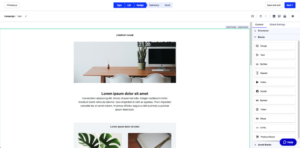
ActiveCampaign gives you 900+ professionally designed email templates. That is not a typo — 900. Across industries, campaign types, and use cases, there is a starting point for almost anything you could need to send.
The drag-and-drop editor is fast and flexible. You can adjust individual content blocks, change colors and fonts, add image sections, and build multi-column layouts without touching any code. The editor also supports conditional content blocks — meaning different subscribers see different content inside the same email based on their tags, behavior, or custom fields. That is a genuine personalization tool, not just a segmentation filter on who receives the email.
Predictive sending is baked into the Pro plan and above. Instead of scheduling your email for 9am Tuesday and hoping that works for everyone, ActiveCampaign figures out the best delivery time for each individual contact based on their opening patterns. Not time-zone optimization — individual-level optimization. That is a meaningful difference for large lists.
Split testing goes up to five variations simultaneously with automatic winner selection. Most platforms give you two.
HubSpot: Good editor, but best features gated behind Professional
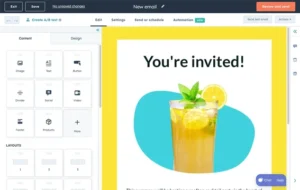
HubSpot’s drag-and-drop editor is clean and intuitive. The recent AI Content Writer integration makes generating email copy faster. And because HubSpot is CRM-first, the personalization tokens pull directly from CRM fields automatically — if you know someone’s company name, job title, and recent activity in your CRM, that information flows into the email without any manual work.
The honest problem: A/B testing, conditional content, and predictive analytics are all locked behind the Professional plan at $890 a month. On Starter at $20 a month, the email builder is competent but stripped of the features that make it genuinely competitive with ActiveCampaign.
A reviewer on G2 put it plainly: “The email capabilities at the Starter level are basic to the point of being disappointing. To get what I actually needed, I had to upgrade to Professional.” That is a $870 a month jump to unlock features ActiveCampaign includes at a fraction of the cost.
Winner: ActiveCampaign — 900+ templates vs a smaller library, conditional content available at lower plan tiers, and five-variation split testing. HubSpot’s email strengths are real but require Professional pricing to access.
Template Library
The template library is what saves you time every week — especially when you need to move fast on a campaign and cannot start from a blank canvas every time.
ActiveCampaign: 900+ templates built for real use cases
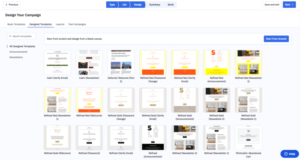
ActiveCampaign’s template library is the largest of any email platform I have tested at this price point. The designs cover newsletters, promotional campaigns, lead nurture sequences, re-engagement emails, product announcements, event invitations, and ecommerce flows. They are professionally designed, mobile-responsive, and categorized clearly enough that finding the right starting point takes minutes, not hours.
You can also save your own branded templates for reuse. So if you have built the perfect layout for your monthly newsletter, it is one click away the next time you sit down to write it.
The AI template generation tool builds email drafts from plain-language prompts. The output is a starting point, not a finished product — but for getting past the blank page, it is genuinely useful.
HubSpot: Fewer templates, gated by plan
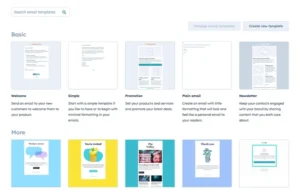
HubSpot has a solid template library, but it is smaller than ActiveCampaign’s and the best designs are locked behind paid tiers. Free plan users get basic templates only — no custom branding, no design variety.
On Starter and above, the template quality is good and the CRM-connected personalization makes them feel more dynamic than they look on the surface. But in terms of raw variety and volume, HubSpot’s library does not compete with ActiveCampaign’s 900+.
One specific thing HubSpot does better: the asset reuse system. Images, videos, and content blocks can be shared across emails, landing pages, and social posts without re-uploading. If you are running integrated campaigns across multiple channels, that content library is a real time-saver. ActiveCampaign does not have an equivalent.
Winner: ActiveCampaign on volume and variety. HubSpot if cross-channel asset reuse matters to how you build campaigns.
Automation
This is the category that defines this comparison more than any other. And here the difference is stark.
ActiveCampaign: Best-in-class email automation in its price range
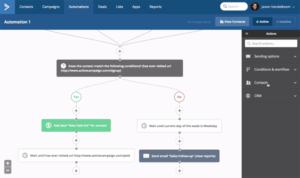
ActiveCampaign’s visual automation builder is the reason 180,000 businesses pay for the platform. It is, in my testing and in the consensus of independent reviewers, the best email automation tool available below enterprise pricing.
You can build workflows triggered by email opens, clicks, website page visits, form submissions, purchases, custom field changes, tags, deal stage updates, and actions in third-party tools. The branching logic is deep — you can build dozens of conditional paths inside a single automation that reacts differently to every possible subscriber behavior.
The AI automation features are worth calling out specifically. AI-suggested segments use plain language to build contact groups (“contacts who clicked pricing links but did not buy in 30 days”). AI-generated automation recipes build workflow drafts from prompts. The Active Intelligence feature, expanded to all plans in late 2025, uses machine learning to predict which contacts are most likely to convert and adjusts campaign priorities accordingly.
Pre-built automation recipes (900+ of them) mean you are not starting from scratch for common use cases. A full abandoned cart sequence, a re-engagement campaign, a lead scoring system — all available as templates you can adapt rather than build from zero.
The honest limitation: the Starter plan caps automations at five actions each. Five. That is so restrictive it makes the Starter plan almost unusable for real marketing. Budget for Plus from day one. That is where ActiveCampaign actually starts to deliver on its reputation.
HubSpot: Powerful automation tied to a CRM, gated by plan
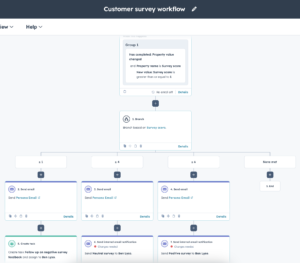
HubSpot’s automation is genuinely capable — but the context matters. HubSpot’s automation works best when it is connected to the CRM layer. Workflows can trigger based on lifecycle stage changes, deal updates, service ticket activity, and marketing engagement all at once. For a business where marketing and sales are deeply integrated, that cross-functional automation is something ActiveCampaign cannot replicate.
The Starter plan has basic workflow automation. Real marketing automation — multi-step, conditional, behavior-based sequences — requires Professional at $890 a month. That is not a minor inconvenience. That is a plan that costs more per month than most small businesses’ entire marketing technology budget.
HubSpot’s own Starter plan page says: “No workflows or email sequences.” That is the honest description of what $20 a month gets you in terms of automation.
Winner: ActiveCampaign at any comparable price point. HubSpot’s automation depth on Professional is impressive — but accessing it costs ten to fifteen times what ActiveCampaign charges for equivalent functionality.
Segmentation & List Management
ActiveCampaign: Deep and flexible — with a billing problem attached
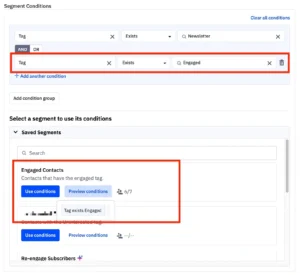
ActiveCampaign’s segmentation is excellent. You can filter contacts by email behavior, website visits, purchase history, tags, custom fields, lead scores, CRM deal data, and actions in connected apps. The AI-suggested segment builder lets you describe what you want in plain language and builds the filter for you.
The contact management system is single-list-based. No confusing multi-audience structure. One contact exists once regardless of how many tags or lists they belong to.
But here is the billing problem: since November 2025, new ActiveCampaign accounts are charged for all contacts — including unsubscribed, bounced, and unconfirmed. That is the same billing practice that has made Mailchimp so widely criticized. For businesses with older lists that have accumulated inactive contacts over time, this means paying for people you cannot email.
The platform recommends archiving contacts to avoid this, but archiving has monthly limits — usually equivalent to your plan’s contact cap — and archived contacts are only stored for one year before deletion. It is a workable solution, but it adds administrative overhead that should not exist in the first place.
A reviewer on EmailTooltester called it plainly: “Not common or fair for ESPs to charge this way.” That is accurate.
HubSpot: The strongest list management of any tool in this comparison
HubSpot’s contact and list management is where its CRM foundation genuinely shines.
You can create dynamic lists that update automatically as contacts meet or leave conditions. Static lists for fixed groups. Smart lists that sync with live CRM data. Lifecycle stage tracking that moves contacts through awareness, consideration, decision, and retention stages automatically based on behavior.
Because HubSpot CRM stores every interaction — emails sent, calls logged, deals updated, support tickets opened — the segmentation you can build is genuinely richer than what any email-only tool can match. You are not just segmenting by email behavior. You are segmenting by the full picture of someone’s relationship with your business.
The billing model for contacts is also cleaner at most tiers. Marketing contacts (the ones you actively market to) are what drive your cost — not every contact in your database. You can have millions of CRM contacts and only pay for the subset you are actively marketing to.
Winner: HubSpot for list management depth and billing structure at scale. ActiveCampaign for segmentation flexibility without HubSpot’s pricing complexity — but the November 2025 billing change took a real hit to its value here.
CRM & Sales Tools
ActiveCampaign: Functional for email-led teams, limited for complex sales operations
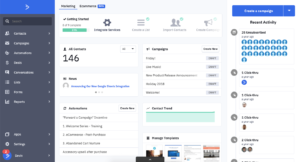
ActiveCampaign has a built-in CRM available as an add-on on Plus and above. You can track deals, manage pipelines, log notes, set reminders, and connect email activity directly to deal stages.
For a small sales team with a straightforward pipeline, this is enough. The integration between email automation and CRM is tight — a deal stage change can trigger an automation, an email click can update a deal, a form submission can create a new deal automatically.
What it is not: a replacement for Salesforce, HubSpot, or any serious CRM for teams with complex sales operations, multiple pipeline stages, forecasting needs, or more than a handful of reps. The CRM is an add-on to an email tool, and it feels like it.
The Pipelines add-on starts at $49 a month on top of the base plan. The Sales Engagement add-on starts at $85 a month. These add up quickly for businesses that need serious sales infrastructure.
HubSpot: The best CRM in this comparison — and arguably in its category
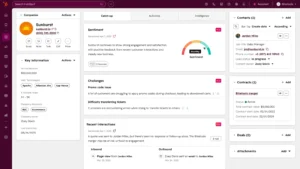
HubSpot’s Smart CRM is the core of the entire platform. Everything else — marketing, sales, service, content — is built on top of it. That architecture means:
Every contact record holds the complete history of every interaction — emails opened, pages visited, calls logged, deals updated, support tickets raised. Sales reps can see exactly what marketing emails a prospect received before their first call. Service agents can see what deals were closed before a support ticket was opened. That shared visibility across teams is genuinely transformative for businesses that have tried to stitch this together with separate tools.
Pipeline management, forecasting, deal routing, sequence-based outreach, and multi-step sales automation are all available through Sales Hub. Service Hub adds ticketing, knowledge base, and SLA management. All of it connects to the same customer record.
The Gartner Magic Quadrant named HubSpot a Leader in B2B Marketing Automation for 2025. That recognition reflects a real capability advantage in CRM-connected marketing for businesses that can use the full platform.
The honest caveat: accessing this capability costs real money. HubSpot Professional — where the full CRM-connected automation lives — starts at $890 a month for Marketing Hub alone. If you need Sales Hub too, add another $500 a month minimum. The full Professional Customer Platform is $1,300 a month for five seats.
Winner: HubSpot — not close. But the win only matters if you need and can afford what HubSpot CRM actually is. For most small businesses, ActiveCampaign’s CRM add-on is enough.
Forms & Landing Pages
ActiveCampaign: Solid, but landing pages are a newer feature
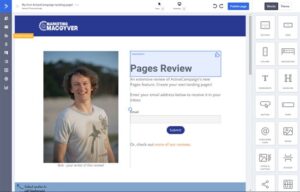
ActiveCampaign gives you multiple form types — embedded, floating bar, pop-up, and modal. The form builder connects directly to your automation workflows, so a form submission can immediately trigger a welcome sequence, add tags, update a deal, or send an internal notification.
Landing pages are available on Plus and above. The builder is functional and supports dynamic content on higher-tier plans — meaning different visitors see different page content based on who they are or what they have done.
The honest limitation: landing pages feel like an add-on to ActiveCampaign’s core product rather than a deeply developed feature. The template selection is smaller than dedicated landing page tools, and the builder does not have the same polish as the email editor.
HubSpot: Landing pages and forms as part of a broader content system
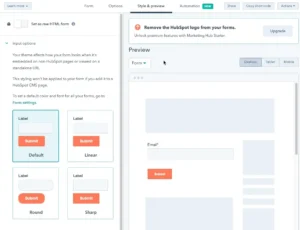
HubSpot’s form and landing page builder is more developed — and more deeply connected to the CRM than any other tool in this comparison.
Every form submission goes directly into the CRM with full attribution. You can see which landing page a contact converted on, which ad drove them there, and how their behavior changed after that conversion. That end-to-end attribution from first touch to closed deal is what HubSpot’s reporting chapter is built around.
The landing page A/B testing is solid. Smart content lets you show different page versions to different visitor types. And the asset library means images and content built for one landing page can be reused across emails and social without re-uploading.
On the downside: the best landing page features — smart content, A/B testing, and custom reporting — are Professional-tier features. On Starter, the landing page builder is functional but basic.
Winner: HubSpot for CRM-connected attribution and content reuse. ActiveCampaign for the form-to-automation connection. Both have real limitations at lower plan tiers.
Deliverability
This is one of the clearest wins in the entire comparison — and it matters more than most people give it credit for.
If your emails land in spam folders instead of inboxes, open rates drop, click rates drop, revenue drops, and your list slowly becomes less valuable. Deliverability is not a secondary concern. It is the foundation everything else is built on.
<cite index=”32-1″>In independent EmailTooltester deliverability testing, ActiveCampaign scored 94.2%, ranking first overall out of all platforms tested. HubSpot scored 77.7%, ranking 12th out of 16 platforms.</cite>
That 16.5 percentage point gap is not a rounding error. On a list of 50,000 contacts, that difference means roughly 8,000 more emails landing in the inbox with every single send on ActiveCampaign compared to HubSpot.
Over a year of weekly sends, that compounds into a significant amount of missed opens, missed clicks, and missed revenue.
HubSpot’s deliverability score likely reflects the fact that it handles enormous volume across millions of accounts with varying list quality and sending practices. ActiveCampaign’s stricter account review process and dedicated deliverability infrastructure appear to produce more consistent results.
Winner: ActiveCampaign — and it is not close. A 16.5 point gap in deliverability is one of the most concrete performance differences in this comparison.
Integrations
ActiveCampaign: 900+ integrations, strong across the marketing stack
ActiveCampaign connects to over 900 apps. Shopify, WooCommerce, Salesforce, HubSpot CRM, Stripe, PayPal, Calendly, Typeform, WordPress, and most tools a small to mid-size business would use are all there. The API is well-documented for custom connections.
One integration worth calling out specifically: ActiveCampaign became the first email marketing platform in Claude’s official MCP partner directory in late 2025. That means it can connect with external AI tools in ways that most other email platforms cannot yet. For businesses experimenting with AI-assisted marketing, that infrastructure matters.
HubSpot: 2,000+ integrations across the full business stack
HubSpot’s app marketplace has over 2,000 native integrations. The breadth covers not just marketing tools but CRM systems, sales platforms, finance software, customer service tools, and data infrastructure. If you are running HubSpot as your primary business platform, the chances of a native integration with whatever you already use are high.
The Zapier connection exists for both platforms, expanding options beyond native integrations when needed.
Winner: HubSpot on raw integration count — 2,000+ vs 900+. For businesses using HubSpot as a platform, this breadth matters. For email-focused businesses using ActiveCampaign, 900+ covers the vast majority of what they will ever need.
Multi-Channel Marketing
ActiveCampaign: Email, SMS, Facebook Audiences, and live chat
ActiveCampaign lets you reach subscribers through email, SMS (available as an add-on), Facebook Custom Audiences sync, and live chat through its site messaging tool.
The Facebook Audiences sync is genuinely useful for retargeting. When a subscriber clicks a pricing email but does not buy, they can be automatically added to a Facebook retargeting audience. When they convert, they are removed automatically so you stop spending ad budget on them. That workflow runs in the background without manual management.
HubSpot: Email, SMS, social ads, social posting, SEO, and content
HubSpot goes significantly further on multi-channel reach.
On top of email, you get SMS (in select countries), Facebook and Instagram ad management, Google Ads management, organic social posting to multiple platforms, website and SEO tools through Content Hub, and live chat through the Service Hub.
The ability to manage email campaigns, retargeting ads, organic social, and website content — all connected to the same CRM record and the same attribution model — is something no email-specialist tool can replicate.
HubSpot also added AI Search Optimization tools in 2026, designed specifically to help businesses appear in AI-generated answers from tools like ChatGPT and Perplexity. For B2B companies worried about organic traffic declining as AI changes search behavior, this is a genuinely forward-looking feature.
Winner: HubSpot for multi-channel breadth. ActiveCampaign’s Facebook Audiences sync is useful, but it is a specific tool compared to HubSpot’s full go-to-market channel coverage.
Reporting & Analytics
ActiveCampaign: Strong email reporting, solid attribution on higher plans
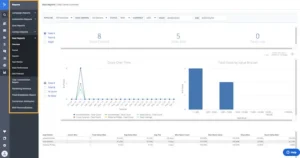
ActiveCampaign gives you opens, clicks, unsubscribes, bounce rates, revenue per campaign for ecommerce, automation performance reports, and contact-level engagement tracking. The reporting is clear and actionable for email-focused teams.
On Professional and above, you get split-test results, conversion attribution, and custom reporting that lets you build dashboards around the specific metrics your business tracks. The AI insights layer recommends next steps — what to adjust, which segments to prioritize, when to send — rather than just showing you what happened.
The honest gap: custom reporting is a paid add-on starting at $159 a month, on top of the base plan. For businesses that need deep cross-campaign analytics, that adds meaningful cost to what already scales by contact count.
HubSpot: The strongest reporting in this comparison — on Professional
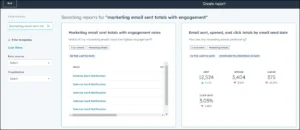
HubSpot’s reporting on Professional and Enterprise is genuinely excellent. Multi-touch revenue attribution shows you the full journey from first marketing touch to closed deal. Customer journey analytics identify where leads drop off in the funnel. Campaign-level reporting connects email, ads, and social into one unified performance view.
The ability to see a clear line from an email campaign to a closed deal — with all the touchpoints in between — is one of HubSpot’s most compelling capabilities for B2B teams that want to prove marketing ROI to leadership.
The honest problem: all of this is Professional-tier functionality. On Starter, the reporting is closer to ActiveCampaign’s standard email metrics than to what HubSpot’s platform is capable of. You are paying for the promise of Professional-grade reporting without accessing it until you cross the $890 a month threshold.
Winner: HubSpot on Professional for attribution depth and cross-channel reporting. ActiveCampaign for email-specific reporting at a fraction of the price. If you need the full picture, HubSpot wins — if you can afford to get there.
Pricing: The Full Honest Picture
This is the section that changes the most minds. Let me give you the real numbers — not the headline prices that lead every other comparison post.
ActiveCampaign Pricing
ActiveCampaign has four plans: Starter, Plus, Professional, and Enterprise.
The Starter plan starts at $15 a month for 1,000 contacts on annual billing. It includes email marketing, basic automations, and marketing CRM. What it does not include: more than five automation actions per workflow. That limitation makes Starter nearly useless for real marketing. You will hit the ceiling within days of setting up your first welcome sequence.
The Plus plan starts at $49 a month for 1,000 contacts. This is where ActiveCampaign actually starts to deliver on its reputation. You get unlimited automation actions, landing pages, lead scoring, SMS marketing, and the full CRM functionality. For most serious users, Plus is the real starting point.
The Professional plan starts at $149 a month for 1,000 contacts. This adds predictive sending, site messaging, attribution reporting, and split automation. For businesses running high-volume campaigns where conversion rate improvements justify the cost.
The Enterprise plan starts at $259 a month for 1,000 contacts. Custom reporting, dedicated support, custom mail server domains, and HIPAA compliance. For large organizations with specific compliance needs.
How costs scale on Plus at common list sizes:
- 1,000 contacts: $49 a month
- 2,500 contacts: $95 a month
- 5,000 contacts: $149 a month
- 10,000 contacts: $189 a month
- 25,000 contacts: $369 a month
The ActiveCampaign billing warning:
In November 2025, ActiveCampaign changed its billing policy for new accounts. New users are now charged for all contacts in their account — including unsubscribed, bounced, and unconfirmed contacts. Pre-November accounts are grandfathered on the old active-contact-only billing.
If you are signing up today and have a list with any history of churn, bounces, or unsubscribes — your billable contact count will be higher than your emailable contact count. Regularly archiving inactive contacts is the only way to manage this, and archiving has monthly limits.
It is the same billing practice that has made Mailchimp widely criticized. The fact that ActiveCampaign has now adopted it is a real disappointment.
Add-ons also stack up. The CRM Pipelines add-on starts at $49 a month. Sales Engagement starts at $85 a month. Custom reporting starts at $159 a month. A business using email marketing plus CRM plus custom reporting can easily double their base plan cost before factoring in contact-based scaling.
HubSpot Pricing
HubSpot has a modular pricing structure with separate hubs for Marketing, Sales, Service, Content, and Operations. I will focus on Marketing Hub here since that is what most people comparing these two tools actually need.
The Free CRM is genuinely free with no time limit. You get up to 1 million contacts, basic contact management, email tracking, forms, live chat, and meeting scheduling. No automation. No custom reporting. HubSpot branding on everything client-facing. It is a real product — not a demo — and it is the best free CRM available for businesses that just need contact management.
The Starter plan starts at $20 per seat per month ($15 on annual billing with current promotional pricing). It removes HubSpot branding, adds basic automation, and is honest about its limitations. The email capabilities are functional. The automation is basic. For a solo founder who just wants a CRM with email, it works.
The Professional plan is where everything changes — and where the honest story needs to be told clearly.
Marketing Hub Professional starts at $890 a month for three seats and 2,000 marketing contacts. That is the base price. On top of it, HubSpot charges a mandatory, non-negotiable, non-refundable $3,000 onboarding fee. This is billed in year one regardless of whether you need it.
Year one total for Marketing Hub Professional at the base level: $10,680 in subscription plus $3,000 onboarding = $13,680.
That is before you add extra seats ($45 a month each), extra contacts (roughly $50 a month per additional 1,000 marketing contacts beyond your tier), or any other hubs.
If you need Sales Hub Professional too ($100 per seat per month with a $1,500 onboarding fee), you are looking at another $6,000+ per year minimum for a small sales team.
Multiple sources describe this as a 44-times price jump from Starter to Professional. That is accurate. And the jump is not optional — the features that make HubSpot genuinely powerful live on Professional. Starter is a capable contact manager with basic email. Professional is the automation platform people mean when they recommend HubSpot.
Marketing Hub Professional costs at common contact tiers:
- 2,000 contacts: $890 a month + $3,000 onboarding year one
- 5,000 contacts: approximately $1,040 a month + onboarding
- 10,000 contacts: approximately $1,290 a month + onboarding
- 25,000 contacts: approximately $1,790 a month + onboarding
The Enterprise plan starts at $3,600 a month for Marketing Hub alone, with a $7,000 onboarding fee. A 50-person company running Marketing and Sales Enterprise can exceed $125,000 in annual spend before implementation costs.
Side-by-Side at Comparable Feature Levels:
| What You Get | ActiveCampaign Plus | HubSpot Marketing Professional |
|---|---|---|
| Full automation workflows | $49 a month | $890 a month |
| A/B testing | Included | $890 a month |
| Conditional content in emails | Included | $890 a month |
| Lead scoring | Included | $890 a month |
| Year one total (1,000 contacts) | ~$588 | ~$13,680 |
The math is not subtle. If you are buying HubSpot for email automation, you are paying 23 times more in year one for features ActiveCampaign includes on its Plus plan.
Customer Support
ActiveCampaign: Support quality tracks your plan level
ActiveCampaign offers email support on Starter, chat support on Plus, and priority support on Professional and Enterprise. Response times are generally good for the email-heavy community that uses the platform — and the knowledge base is extensive enough that most common issues can be self-resolved.
The honest note: lower-tier users describe support as documentation-heavy. You get pointed to articles more often than you get a real person walking through your specific problem. Priority help effectively starts at Professional.
HubSpot: Excellent support infrastructure, gated by plan
HubSpot’s support infrastructure is one of the best in the category. Phone support, email support, chat support, and a massive community forum with millions of threads covering almost every question you could have.
HubSpot Academy is worth calling out specifically. Free courses, certifications, and training materials covering inbound marketing, sales, service, and the platform itself. For a team getting started on HubSpot, the Academy is a genuinely useful resource that reduces the onboarding investment.
The catch: the depth of available support scales with your plan. Free and Starter users get community support and documentation. Professional and Enterprise users get direct access to real human support on demand.
Winner: HubSpot for support depth and training resources — particularly HubSpot Academy. ActiveCampaign if you are on a plan that gets adequate support and do not need the full HubSpot training ecosystem.
AI Features
Both platforms have invested significantly in AI in 2025 and 2026. But they have taken different approaches.
ActiveCampaign: AI focused on email marketing execution
ActiveCampaign’s AI features — under the Active Intelligence banner — are concentrated on the things email marketers actually do. Predictive sending for individual contact optimization. AI-generated automation recipes that build workflow drafts from plain-language descriptions. AI-suggested segments based on behavioral descriptions rather than manual filter building. Automated campaign performance recommendations that tell you what to adjust rather than just showing you data.
In February 2026, ActiveCampaign acquired Feedback Intelligence, an AI evaluation platform designed to create a feedback loop between campaign outcomes and future creative decisions. Too early to judge the results, but the direction is right.
HubSpot: AI across the entire go-to-market motion
HubSpot’s Breeze AI is more ambitious in scope. It covers content generation, email copy, social posts, blog articles, and campaign briefs. Breeze Agents are AI-powered workers that handle specific tasks — prospecting agents that research companies and identify buying signals, customer service agents that handle support tickets, and marketing agents that execute campaign workflows.
The AI Search Optimization feature — which helps businesses appear in AI-generated answers from ChatGPT, Perplexity, and other AI tools — is the most forward-looking thing either platform has built. HubSpot’s own data showed their customers’ organic search traffic dropped 27% year-over-year in 2025 as AI tools began answering queries directly. The AEO tools are a direct response to that shift.
Winner: HubSpot for AI breadth across the full revenue motion. ActiveCampaign for AI features specifically tuned to email marketing workflows. Which one is more valuable depends entirely on whether you need AI helping just email or helping your entire go-to-market motion.
What Real Users Are Saying
I went through hundreds of reviews on G2 and Capterra. Here is what patterns show up consistently in long-term reviews — not just first impressions.
On ActiveCampaign’s automation:
The automation builder gets genuine, sustained praise across G2. Users who have been on the platform for one to three years consistently describe it as the feature that makes everything else worth the investment. One G2 reviewer with a SaaS company said ActiveCampaign gave them the ability to build customer journeys that reacted to in-app behavior and email engagement simultaneously — something they had previously needed separate enterprise tools to accomplish.
On ActiveCampaign’s learning curve and pricing surprises:
“Learning Curve” and “Expensive” are the two most mentioned cons on G2 — appearing in 419 and 403 reviews respectively. The specific complaint about pricing: people sign up expecting the $15 a month Starter price and discover it is essentially unusable for real automation. The jump to Plus at $49 a month for 1,000 contacts is where the real product lives — and the November 2025 billing change for inactive contacts has made that discovery even more frustrating for new users.
One Reddit thread from early 2026 described a 30 percent price increase during the 2024 plan migration with no clear communication beforehand. The sentiment was not anger at the price itself — it was the lack of transparency.
On HubSpot’s all-in-one value:
The users who love HubSpot most are almost always running it across multiple teams — marketing, sales, and service all in the same platform. The most consistent praise is about visibility: everyone working from the same customer record, no handoff friction between teams, and attribution that follows a lead from first ad click to closed deal without gaps.
One G2 reviewer at a B2B SaaS company described HubSpot as the first tool that made their marketing team and sales team feel like they were working toward the same goals with the same data. That is a real capability advantage for businesses complex enough to need it.
On HubSpot’s pricing cliff:
This is the single most-cited complaint in HubSpot reviews — appearing across G2, Capterra, and independent analysis. The 44-times jump from Starter to Professional is jarring. The mandatory $3,000 onboarding fee that appears on your first Professional invoice surprises many buyers who saw only the $890 a month headline price.
One G2 reviewer described the sales process clearly: “It’s clear that their process is designed to push expensive products, not to help business owners make informed decisions.” That is a harsh assessment — but it reflects a pricing structure that creates genuine sticker shock for anyone who does not model out the full year-one cost before signing.
My Honest Take After Testing Both
Here is where I land after testing both platforms properly across real business accounts.
ActiveCampaign is the right choice for the vast majority of businesses comparing these two tools. The automation depth is genuine and accessible at a price that makes sense for companies that are not running enterprise budgets. The deliverability lead is meaningful and documented. The 900+ templates, conditional content, five-way split testing, and AI automation features are real — not locked behind a plan that costs more than most marketing budgets.
The November 2025 billing change for inactive contacts is a real problem and a real disappointment. It makes ActiveCampaign meaningfully worse for businesses with older lists. But it does not change the fact that the automation builder is still the best available at this price point.
The Starter plan is a trap. Do not sign up for it and expect to do real marketing. Budget for Plus from day one and save yourself the frustration.
HubSpot is the right choice for B2B companies that genuinely need marketing, sales, and service unified. The CRM depth, the cross-team visibility, the attribution reporting, and the AI breadth of Breeze are real advantages — but only for businesses complex enough to need them and funded enough to afford them.
If you are a 30-person B2B company with a sales team, a marketing team, and a service team that currently uses four separate tools and spends significant time trying to keep them in sync — HubSpot Professional is probably worth the $13,680 year one investment. You will consolidate tools, eliminate data silos, and finally be able to see the full customer journey in one place.
If you are a small business, a creator, or a company whose primary marketing motion is email — HubSpot at Professional pricing is the wrong tool for your budget. You will pay for an enterprise platform to send newsletters.
One last honest note: before committing to either platform, model out your year-one cost at your actual contact count, with your actual team size, on the actual plan tier where the features you need live. Both platforms have headline prices that significantly understate what most businesses actually pay. Run the real math before you sign.
Frequently Asked Questions
Is ActiveCampaign better than HubSpot?
For email marketing and automation at a reasonable price — yes. ActiveCampaign’s automation depth, deliverability (94.2% vs HubSpot’s 77.7%), and feature accessibility at lower plan tiers make it the better choice for businesses whose primary need is email. HubSpot is better if you need CRM, sales, and service unified in one platform and have the budget for Professional pricing.
How much does HubSpot Marketing Hub Professional actually cost?
$890 a month for the base plan (3 seats, 2,000 marketing contacts) plus a mandatory $3,000 non-refundable onboarding fee in year one. That is $13,680 in year one at the entry level — before adding extra seats, extra contacts, or other hubs.
Does ActiveCampaign charge for unsubscribed contacts?
For accounts created after November 3, 2025 — yes. New ActiveCampaign accounts are billed for all contacts including unsubscribed, bounced, and unconfirmed. Accounts created before that date are grandfathered on active-contact-only billing.
What is the difference between HubSpot Starter and Professional?
Starter ($20 per seat per month) includes basic email marketing, contact management, simple automation, and HubSpot branding removal. Professional ($890 a month) adds full marketing automation workflows, A/B testing, conditional content, custom reporting, lead scoring, and the features that make HubSpot genuinely competitive with specialist tools. The gap is enormous — and so is the price jump.
Is HubSpot’s free CRM worth using?
Yes, genuinely. The free CRM gives you unlimited users, up to 1 million contacts, deal tracking, email tracking, forms, and live chat at no cost. It is a real product. The limitations are no automation workflows, no custom reports, and HubSpot branding on client-facing tools. For businesses that just need contact management and basic email, the free CRM is excellent value.
Which has better email deliverability — ActiveCampaign or HubSpot?
ActiveCampaign scored 94.2% in independent EmailTooltester deliverability testing, ranking first overall. HubSpot scored 77.7%, ranking 12th out of 16 platforms tested. That 16.5 point gap means roughly 1 in 6 HubSpot emails that ActiveCampaign would deliver to the inbox ends up in spam instead.
