
Last Updated: 04 Mar 2026
Email Marketing vs. Social Media in 2026: The Truth No One Tells You (And My Secret Strategy That Combines Both)
Last Updated: March 2026
A few weeks ago, I opened my inbox to a message from one of my clients.
The subject line? “Is email even worth it anymore?”
Inside, he wrote:
“Hey Kartik, I was watching a big YouTuber yesterday, and he said email marketing is dead. He claimed social media is the only platform where I can actually get clients and leads. What do you think?”
I smiled. Because I’ve heard this exact concern dozens of times — from startup founders, coaches, agency owners, and e-commerce brands. And every single time, my answer is the same:
Email marketing isn’t dead. If anything, it’s never been more powerful.
But here’s what I’ve learned after running campaigns for clients across industries: the real question isn’t email vs. social. The real question is how do you make them work together?
I’ve seen businesses lose 80% of their reach overnight because of an algorithm update — and survive entirely because of their email list. I’ve seen other businesses pour thousands into Instagram ads that generated zero sustainable growth. And I’ve personally built a client acquisition system where social media starts the conversation, and email closes the deal — every time.
In this guide, I’m going to share everything I know. The data, the strategy, the mistakes, and the exact playbook I use inside my agency. By the end of this, you won’t have to guess which channel deserves your attention. You’ll know.
The Data: Is Email Really Still Alive?
Before I share my strategy, let me show you the numbers — because they tell a story that social media gurus conveniently ignore.
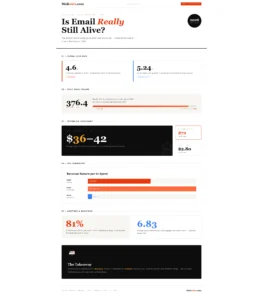
Email is growing, not dying.
According to current data, there are 4.6 billion email users globally in 2025, projected to hit 4.73 billion by 2026. That’s more than half the planet’s population sitting in an inbox, ready to be reached. Meanwhile, 376.4 billion emails are sent and received every single day — a number expected to cross 408 billion by 2027.
When I look at those figures, I don’t see a dying channel. I see an infrastructure that the world runs on.
And adoption among businesses? 81% of companies actively use email in their marketing strategy. Not because it’s trendy — because it works.
The ROI tells the clearest story of all.
I always come back to this number when I’m talking to skeptical clients: for every $1 spent on email marketing, businesses see an average return of $36 to $42. Some sources put it even higher — ecommerce brands in the US report returns of $72 for every dollar spent. Compare that to social media’s estimated return of $2.80 per $1 spent, and you start to understand why I keep coming back to email, every single time.
And here’s the thing about social media:
As of early 2025, 5.24 billion people use social media worldwide, and the average user actively engages on 6.83 different platforms every month. Those numbers are impressive. Social media is genuinely one of the best tools for getting discovered.
But discovery and revenue are two very different things.
Reach & Control: Who Really Owns Your Audience?
This is the question I ask every client I work with: If Instagram shut down tomorrow, what would you have left?
Most people go quiet when I ask that.
Here’s the uncomfortable truth I’ve learned from working with businesses over the years: on social media, your audience doesn’t belong to you. It belongs to the algorithm.
You could build 50,000 followers, wake up to an algorithm update, and suddenly only a fraction of them see your posts. I’ve watched this happen firsthand. One client I worked with had built a significant Facebook page over years — and after a single update, their organic reach tanked overnight. The business survived only because we had been quietly building their email list in parallel.
The data backs this up completely. Organic reach on Instagram sits at just 4%, while Facebook content reaches under 1% of followers on average. You can have 100,000 fans and realistically reach fewer than 1,000 of them without paying to boost the post.
Email is the opposite of all this.
When someone subscribes to your email list, they’re explicitly saying: “Yes, I want to hear from you.” And when you hit send, 98% of emails are successfully delivered — no algorithm deciding who sees it, no bidding war to reach your own audience, no platform throttling your message.
I often describe it this way to clients: social media is rented land. Your email list is land you own.
The landlord can change the rules on rented land at any moment. But no one can take away your email list. You can export it, move it to a different platform, and keep reaching your audience regardless of what any tech company decides to do.
That asymmetry in ownership is something I’ve built my entire client acquisition system around.
ROI & Cost: Where Does Your Money Actually Go?
Let me be direct with you here, because I see businesses waste money on this every single month.
The cost gap between email and social is significant — and most people don’t realize how wide it is until they run the numbers.
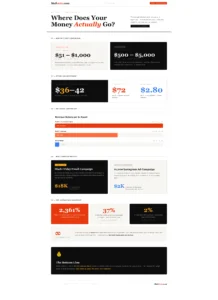
Monthly costs for email marketing range from $51 to $1,000, depending on your list size and platform. Social media marketing, when you factor in ads and content creation, runs $500 to $5,000 per month — and that number climbs fast as competition increases and ad auction prices go up.
More importantly, the returns are incomparable. Email delivers $36–$42 per dollar spent. Social media delivers roughly $2.80 per dollar spent. That’s not a small gap. That’s a completely different category of marketing efficiency.
I’ve run both, side by side, and I’ve seen this play out in real campaigns.
One of my e-commerce clients was nervous about competing during Black Friday. Instead of pouring money into ads, we doubled down on their email list. With a modest investment in copywriting and a targeted sequence, we generated over $18,000 in sales in under two weeks. Meanwhile, another client’s $1,000 Instagram ad campaign returned $2,000 — technically profitable, but the moment the ads stopped, so did the sales. Zero leverage, zero long-term asset.
There’s also the automation advantage that most people miss. Automated email campaigns deliver a 2,361% higher conversion rate compared to standard scheduled campaigns, and automated emails generate 37% of all email orders from just 2% of total sends. That means a workflow you set up once keeps compounding returns while you sleep.
That’s not something any social media post can do.
Engagement & Conversions: The Numbers That Matter
I want to be honest about something: raw engagement numbers on social media look impressive. Thousands of likes, hundreds of comments, shares going viral. It feels great.
But here’s what I’ve learned to ask: How much of that engagement actually turns into revenue?
The data is sobering. Email generates 174% more conversions than social media, according to Campaign Monitor research. And when I look at click-through rates, the gap is even wider — email consistently delivers 50 to 100 times the click-through rate of Facebook and Twitter.
The conversion picture is just as clear. Email marketing achieves conversion rates of 2.8% for B2C and 2.4% for B2B brands, compared to social media’s average of around 1.9% for paid ads — and far less for organic.
I personally experienced this with a consulting client who had spent two months posting thought leadership content on LinkedIn every single day. Solid engagement, consistent impressions, zero sales.
We tested one email to their list of 2,500 subscribers. Within 72 hours: 6 booked calls and 3 closed deals — worth more revenue than two months of daily LinkedIn content combined.
The reason this happens is simple: users spend an average of 11.1 seconds per opened email, compared to just 1.7 seconds on a social media post. When someone opens your email, you have their focused, undivided attention. You’re not competing with memes, breaking news, and their cousin’s vacation photos.
That attention gap is where conversions happen.
Personalization & Trust: The Inbox Advantage
I believe that marketing, at its core, is about making people feel understood. And this is where email has a structural advantage that social media simply cannot replicate.
When I’m writing a social media post, I’m writing for everyone. It has to be broad enough to catch attention across an audience with wildly different contexts, problems, and goals. It’s inherently generic.
But when I send an email, I can speak directly to a specific segment of my audience. Someone who downloaded a particular lead magnet. Someone who clicked a specific link last month. Someone who bought my entry-level offer and is ready for the next step.
The numbers validate this. Personalized emails see a 26% higher open rate when using segmentation and behavior-based triggers. Personalized calls-to-action boost conversion rates by 202% compared to generic ones. And perhaps most importantly for businesses thinking about revenue: targeted and personalized emails are responsible for 58% of all email-generated revenue.
I ran a segmentation experiment with a client’s list, splitting their contacts into cold leads, warm prospects, and past buyers — each receiving slightly different messaging tailored to where they were in their journey. Open rates jumped 24% overnight, and conversions doubled. We didn’t write more emails. We wrote smarter ones.
Social platforms give you targeting tools too, but there’s a fundamental difference: email subscribers opted in. They raised their hand and said, “I want to hear from you.” That voluntary relationship creates a level of trust that paid ad targeting simply cannot manufacture.
Analytics: Can You Actually Measure What’s Working?
Here’s a frustrating reality I run into constantly with clients who are heavy social media users: they can’t tell me which posts actually made them money.
They can show me impressions. They can show me engagement rates. They can show me how a Reel went viral. But when I ask, “How many paying customers came from that post?” — crickets.
Email doesn’t have that problem.
With email, I can see exactly who opened which email, which links they clicked, what they bought afterward, and what the total revenue from that campaign was. 87% of marketing leaders say email is critical to their company’s success, and a big part of that is because it gives you a clear, measurable picture of performance.
A SaaS client I work with was struggling to figure out which offers were actually resonating. Using email analytics, we A/B tested subject lines, CTAs, and pricing tiers across three campaigns. Within a month, we had definitive data showing one pricing model outperformed the others by 3x — and that insight led to a permanent revenue lift.
Contrast that with a viral social media campaign another client ran. It racked up tens of thousands of views and substantial likes. When we checked the backend, actual sign-ups were negligible. They had no way to tie the content to sales. The buzz was there. The bottom line wasn’t moving.
This measurability gap is why I always tell clients: email analytics is a microscope on your revenue engine. Social media analytics is mostly vanity metrics that make you feel good, but rarely pay the bills.
Longevity: What’s Still Working Two Years Later?
This is perhaps the most underappreciated difference between the two channels, and it’s something I’ve come to think about a lot.
Social media content has a lifespan that can be measured in hours. Tweets peak in 15–20 minutes. Instagram posts see the majority of their engagement in the first 48 hours. TikTok videos occasionally resurge, but most fade within days. Once the algorithm moves on, your content is essentially invisible — regardless of how much time you spent creating it.
This creates what I call the content treadmill: you have to keep running just to stay in the same place.
Email is fundamentally different.
About two years ago, I built an automated email sequence for one of my own offers. I wrote it once, set it up, and let it run. I still get sales from that sequence today — without touching it again. The emails sit in the automation, delivering value and making offers to every new subscriber who enters the funnel, on their schedule, not mine.
That’s not a social media post’s lifespan. That’s a business asset.
The underlying reason is structural: an email stays in a subscriber’s inbox until they choose to read it, act on it, or delete it. No algorithm buries it. No feed pushes it out of sight. And with email deliverability currently sitting at 98%, messages consistently reach the people who agreed to receive them.
My mental model for this: social posts are like fireworks — spectacular in the moment, then gone. Email is like planting a tree — you invest once, and it keeps giving.
My Secret Strategy: Why I Never Choose Between Them
Here’s where I want to give you something genuinely useful — the integrated approach I’ve refined over years of running campaigns.
For a long time, I fell into the same trap as most marketers: treating email and social as competitors, thinking I had to choose one and commit. That mindset cost me growth. The moment I stopped choosing and started connecting them, everything changed.
The framework I use is simple:
Social Media = My Attention Machine. Social is where I get discovered by people who don’t know me yet. It’s loud, it’s fast, and it’s designed for reach. I use it to publish content that stops the scroll — short insights, behind-the-scenes moments, strong opinions, quick wins. I’m not trying to sell on social. I’m trying to earn enough attention to earn a click.
Email = My Conversion Engine. Once someone enters my email list, that’s where the real relationship is built. I share deeper content, personal stories, detailed frameworks, and genuine offers. Email is where I have enough space and attention to move someone from “curious” to “convinced.”
Here’s the specific integration I run:
First, I create content on social media that points to a specific lead magnet — a resource that solves a real problem for my target audience. The social post earns the click. The lead magnet earns the email address.
Once someone is on my list, I shift from broadcasting to nurturing. I send 2–3 emails per week: one that teaches something actionable, one that tells a story with a lesson, and one that makes an offer or soft pitch. This rhythm keeps me relevant without being pushy.
The key insight I want you to take from this: social media starts the conversation. Email finishes it. Neither channel is complete without the other. Social without email is attention without conversion. Email without social is depth without reach.
And the data supports exactly this integration. Businesses that combine channels see 23% more conversions, 37% better customer retention, and 41% more revenue growth than those who rely on a single channel.
Real Case Studies From My Work
Case Study 1: The Fitness Brand That Survived an Algorithm Collapse
I studied a fitness brand that had built their entire growth strategy on Instagram. Their reels were performing well, their following was solid, and engagement was strong. Then the algorithm changed.
Reach dropped dramatically — almost overnight. Their social-driven revenue took a serious hit.
But here’s the part of the story that matters: they had been building their email list quietly alongside their social growth. That list, which they had largely underestimated, became their lifeline. While Instagram was failing them, their email subscribers continued generating $20,000 in monthly recurring revenue — untouched by any platform decision.
That’s the safety net I talk about with every client. You can’t control the algorithm. You can control your list.
Case Study 2: From Zero to $50K With Email Alone
A small e-commerce business I worked with had a modest product but a tight budget. Rather than pouring everything into paid ads, we focused for six months on building a quality email list using lead magnets and simple opt-in incentives.
Once the list hit 10,000 subscribers, we ran a focused campaign. Those subscribers generated $50,000 in revenue — all from email, with no ad spend for that campaign. The list had become an asset that could be activated repeatedly, not a one-time spike.
Case Study 3: My Own Agency
When I first started, I made the same mistake most marketers make: I assumed social media would drive business. I spent real time building LinkedIn presence, posting consistently, engaging with others’ content. And I got attention — follows, comments, messages.
But the money didn’t come from likes. It came when I moved people off social and into my email list. That’s where I could share my frameworks in depth, build genuine trust over multiple touchpoints, and make offers that converted. Today, my agency’s formula is unchanged: social builds the audience, email generates the revenue.
Which Channel Should YOU Focus On?
This is the most common question I get, and my answer always depends on where you are in your journey.
If you’re just starting out: Build your email list first. I cannot stress this enough. Your email list is the one marketing asset you fully own. Even if you start with just 50 or 100 subscribers, those are 50 or 100 people you can reach anytime without permission from an algorithm. Use social media as a tool to grow that list — post content that drives people to a lead magnet or newsletter opt-in.
If you already have a social following: You’ve done the hard work of earning attention. Now convert it. Your followers are not yet customers — they’re opportunities. The goal is to move them from your social feed into your inbox, where you can build the kind of trust that leads to sales. Every piece of social content you create should have a pathway to your email list.
If you’re scaling: At this stage, you’re integrating both channels into a system. Social keeps feeding new people into your world. Email keeps nurturing and converting them. Each channel amplifies the other. This is where the compounding effects of integrated marketing really kick in.
The universal principle: Don’t treat these channels as competitors. Treat them as teammates with different jobs. Social is the top-of-funnel discovery engine. Email is the mid-to-bottom-of-funnel trust and conversion engine. Build both, connect them, and let them reinforce each other.
Frequently Asked Questions
Is email marketing better than social media in 2026?
For conversion and ROI — yes, it’s not particularly close. Email delivers $36–$42 for every dollar spent, while social media averages around $2.80. But “better” depends on your goal. For brand discovery and reach, social is invaluable. For building trust and generating sales, email wins. The smartest approach is to use both together, with social feeding people into your email funnel where the real monetization happens.
Can email replace social media?
Not entirely, and I wouldn’t recommend trying. Email is unbeatable for nurturing leads and driving sales. Social is unbeatable for reaching people who don’t know you yet. Each fills a gap the other can’t. My recommendation is always integration, not replacement.
What has a higher ROI — email or social?
Email, and it’s not close. Average returns of $36–$42 per dollar spent versus social media’s $2.80. Automated email workflows push that number even higher. This is why email consistently ranks as the top ROI channel for B2C brands.
Should small businesses start with email or social?
Start with email. It’s your owned asset, and building it early means you’re never fully dependent on any platform’s algorithm. Then use social media as the machine that feeds people into your email list. I’ve seen small businesses with 500 email subscribers outperform competitors with 50,000 social followers — because the list converted while the followers just scrolled.
How do email and social media work together?
The framework I use: social attracts, email converts, both retain. Your social content generates awareness and pulls people toward a lead magnet or newsletter. Your email sequence builds trust and makes offers. Your consistent presence on both channels keeps your audience engaged over time. This integrated loop is where the real growth happens.
Final Thoughts: The Only Question That Actually Matters
After everything I’ve shared — the data, the case studies, the framework — I want to come back to the question my client asked me.
“Is email even worth it anymore?”
The answer I gave him then, and the answer I’d give anyone reading this now: email isn’t just worth it. It’s the most reliable, scalable, and high-return marketing channel available to you.
Social media is an incredible tool for discovery. I use it every week. I recommend it to every client. But I have never, not once, seen a business build sustainable, predictable revenue on social media alone.
The businesses that grow consistently — the ones that survive algorithm changes, ad cost increases, and platform pivots — have one thing in common: they own their audience through an email list.
My challenge to you is simple. If you haven’t started building your email list, start today. If you have a list but aren’t treating it as your primary revenue channel, change that. Use social to feed it, use email to convert it, and watch the two channels start compounding together.
The inbox is still the most powerful place in marketing. I’ve staked my agency on it. The data backs me up. And the businesses that understand this will have a serious competitive advantage over those still chasing algorithm-driven social growth.
Have a question about building your email + social strategy? Drop it in the comments — I read and respond to every one.
Sources & Data References:
- HubSpot State of Marketing Report 2026
- Litmus State of Email 2025
- Omnisend Ecommerce Marketing Benchmarks 2025
- DemandSage Email Marketing Statistics 2026
- Campaign Monitor Email Marketing Benchmarks
- McKinsey & Company Digital Marketing Research
- Mailmunch Email vs. Social Media Study
- Harman Media Email Marketing vs Social Media ROI Comparison 2025
- Saleshandy Email Marketing Statistics 2026
- Battlebridge Email vs. Social Media ROI Guide 2025
