
Last Updated: 11 Jul 2026
Brevo vs Constant Contact: Honest Comparison (2026)
I have tested both of these tools on real email lists.
Not a sponsored review. Not a quick sign-up and a screenshot tour. Real campaigns, real automation sequences, and real money evaluated against what each platform actually delivers.
And I want to be upfront with you before we get into anything: this comparison is not as balanced as the title makes it sound.
Constant Contact has been around since 1995. It built its reputation on being the simplest, most beginner-friendly email tool for small businesses. For a long time, that reputation was earned.
But in 2026, the gap between what Constant Contact offers and what it charges has become very hard to defend. Prices have gone up. Features have stayed basic. And every comparison I have read from people who have tested both platforms recently lands in the same place.
Brevo wins on features. Brevo wins on price. Brevo wins on automation. Brevo wins on multi-channel reach.
Constant Contact wins on phone support and beginner simplicity. That is a real advantage — but it is a narrow one.
I am going to break down every area honestly. But I want you to go in knowing the headline before we get to the details.
Short on Time? Read This First
Brevo is the better tool for most businesses in 2026.
It costs less, does more, includes a free plan, and has a pricing model that does not punish you for growing your list. Multiple users who switched from Constant Contact to Brevo report saving over $600 a year while gaining SMS marketing, advanced automation, and a built-in CRM they did not have before.
Constant Contact is still worth considering if you run a nonprofit, an event-based business, or if phone support is genuinely non-negotiable for your team.
| Feature | Brevo | Constant Contact |
|---|---|---|
| Free plan | ✅ Yes (300/day) | ❌ No |
| Starting price | $9/month | $12/month |
| Pricing model | Email volume | Contact count |
| Full automation on entry plan | ✅ Yes | ❌ Basic only |
| Built-in CRM | ✅ Yes | ❌ No |
| SMS marketing | ✅ Yes | ✅ Add-on |
| WhatsApp and push notifications | ✅ Yes | ❌ No |
| Phone support | ❌ Pro plan only | ✅ All paid plans |
| Event management tools | ❌ No | ✅ Yes |
| G2 rating | 4.5/5 | 4.2/5 |
The one honest warning about Brevo: The pricing model charges by email volume — not contact count. If you email your entire list every single day, the math changes. Run your numbers before assuming Brevo is always cheaper. If you send less than four times a month per contact — and most businesses do — Brevo is almost always the better deal.
What I Tested and How
I signed up for both platforms using real accounts.
I built campaigns, created automation sequences, tested the editors, connected integrations, and dug into the reporting on both sides. I also went through hundreds of verified reviews on G2, Capterra, Software Advice, and independent comparison sites — specifically looking at long-term reviews from people who have used each platform for six months or more.
Here is everything I found.
Ease of Use
Constant Contact: The simplest email tool I have used at this price
Two clicks to get to the campaign editor. A dashboard so clean it feels almost empty. An interface that holds your hand through every step without making you feel like you are missing something.
Constant Contact has been building email tools since 1995. It shows. The onboarding is frictionless — you can log in, create an email, and send it in under 20 minutes without reading a single help article. For a business owner who has never used email marketing software before and just wants to send a newsletter without a learning curve — Constant Contact removes every possible barrier.
One independent reviewer described it as a flip phone — it handles the basics well without adding complexity. That is actually a perfect description. It is not a criticism. Some people need a flip phone. They know what they need and they do not need more.
The honest problem: Constant Contact’s simplicity is partly because there is less to learn. The automation is basic. The segmentation has limited conditions. The reporting is surface-level. The tool feels simple because it is intentionally limited in depth.
Brevo: More capable, slightly more to learn
Brevo is not complicated. But it is not as instantly simple as Constant Contact either.
The dashboard is modern and well-organised. Finding campaigns, contacts, automation, and settings is straightforward once you spend 20 to 30 minutes exploring. Multiple independent reviewers describe a short adjustment period followed by an experience that feels fast, smooth, and intuitive.
The honest note: Brevo’s interface is denser than Constant Contact’s because there is more inside it. A CRM, multi-channel marketing tools, transactional email, SMS — all sitting alongside the email builder. For a beginner who just wants to send emails, the extra options can feel like noise at first.
A Capterra reviewer described drafting and designing emails as occasionally challenging depending on the content — particularly when adding multiple images. That matches what I found in my testing. The editor is capable, but it sometimes requires more configuration than Constant Contact to get a layout looking exactly right.
Winner: Constant Contact for the initial experience. Brevo once you need more than the basics and are willing to invest a few sessions learning the platform.
Email Builder
Constant Contact: Clean editor built for speed

Constant Contact’s drag-and-drop email builder is genuinely well designed for its audience. You pick a template, swap out the content, and you are done. The blocks work intuitively. The mobile preview is built in. Nothing lags.
For a small business owner who needs to send a campaign in 15 minutes without design experience — Constant Contact’s editor gets out of the way and lets you do it.
The honest limitation: customisation is shallow. You can change the content of blocks easily. You cannot fundamentally change the structure of a layout or add content types that go beyond what Constant Contact’s block library supports. Multiple reviewers mention hitting a ceiling when they want something slightly different from what the templates offer.
Brevo: More flexible, requires more setup
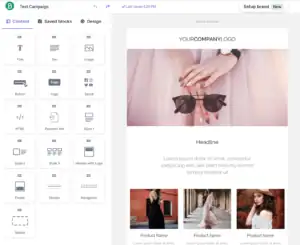
Brevo’s drag-and-drop editor supports more layout options, more content block types, and more structural flexibility than Constant Contact’s. You can build more varied designs and push the layout further when you need to.
The AI writing assistant inside Brevo generates subject lines, preview text, and email body copy. In independent testing, Brevo’s AI suggestions were rated as more creative and higher-performing than Constant Contact’s equivalent — though neither is described as a home run.
The honest trade-off: Brevo’s editor takes a little longer to get comfortable with. Getting specific layouts to look right — particularly emails with multiple images — requires more configuration than Constant Contact. The extra flexibility comes with extra complexity.
Winner: Constant Contact for speed and simplicity. Brevo for flexibility and AI-assisted content generation.
Template Library
Constant Contact: Large library, occasionally overwhelming

Constant Contact gives you a substantial template library covering newsletters, promotions, events, announcements, and seasonal campaigns. The designs are clean and professional.
A Capterra reviewer noted that with many of these platforms there are a lot of templates to use, but the huge library can be a bit overwhelming for new users — too many choices. That is an honest observation. When you have hundreds of options and no strong filtering, finding the right starting point takes longer than it should.
The templates themselves are well-built and mobile-responsive. They cover a wider range of business types than Brevo’s library — particularly for event-focused organisations, nonprofits, and local businesses.
Brevo: Smaller library, but well-organised
Brevo’s template library is smaller than Constant Contact’s. What it has is organised clearly by campaign type and industry, which makes finding a starting point faster despite the smaller total number.
The templates are modern and clean. For email-heavy campaigns focused on promotions, newsletters, and announcements — Brevo’s library covers the common use cases without the paralysis of too many options.
Winner: Constant Contact for variety and breadth — particularly for event-focused and nonprofit organisations. Brevo for a more streamlined selection that is easier to navigate quickly.
Automation
This is where the gap between these two tools becomes most obvious — and where the decision is made for most businesses who need more than a basic welcome email.
Constant Contact: Basic autoresponders, not much more

Constant Contact offers welcome emails, birthday messages, anniversary emails, and basic drip sequences. If someone joins your list, you can automatically send them a welcome email. If their birthday is stored in your contact data, you can send a birthday greeting. You can set up a short linear drip sequence — email one, wait a few days, email two, wait a few days, email three.
That is essentially the ceiling.
There is no multi-step conditional logic. There is no branching based on what someone does. There is no way to build a sequence that sends one email to people who clicked a link and a different email to people who did not. There is no behaviour-based triggering from website visits or purchase actions.
An independent reviewer who tested both platforms described Constant Contact’s automation as great for linear communication but lacking the depth for more complex workflows. That is accurate and fair.
For a nonprofit sending event reminders and a monthly newsletter — Constant Contact’s automation is probably enough. For any business trying to build a real sales or nurture funnel through email — it will frustrate you fast.
Brevo: Multi-step workflows that actually react to behaviour
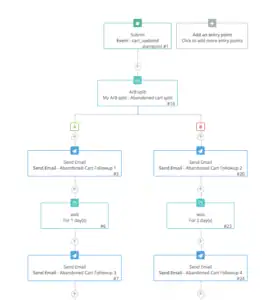
Brevo’s automation builder supports multi-step workflows, conditional branching, and triggers based on email behaviour, website visits, contact field changes, and transactional events.
An independent reviewer who tested both platforms described building paths that change the customer’s journey based on their actions on the website. For example — if someone visits a specific product page, they automatically enter a personalised email sequence about that product. If they click a link in email one, they get email two. If they do not click, they get a different follow-up with a different angle.
That is the kind of automation that moves a subscriber from prospect to customer without manual work. Constant Contact cannot build this.
Brevo also supports automation triggers based on transactional email events — order confirmations, shipping notifications, password resets. These are not marketing emails — they are system emails that most ecommerce and SaaS businesses need to send automatically. Including them in the same automation platform eliminates a separate transactional email tool and its associated cost.
Winner: Brevo — clearly. The gap in automation depth is one of the widest differences between these two platforms. If automation beyond a simple welcome sequence matters to your business, Constant Contact is not the right tool.
Segmentation and Contact Management
Constant Contact: User-friendly list management with clear limits
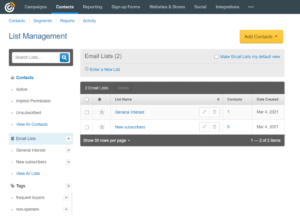
Constant Contact’s contact management is consistently rated well for ease of use. You can import contacts from various sources, organise them into lists, and tag them for basic segmentation. Multiple Capterra reviewers describe the list management as intuitive and efficient.
The segmentation options let you send to specific lists, exclude specific lists, and filter by basic contact data. For a small business with a simple list structure — customers, newsletter subscribers, event attendees — this covers the everyday needs without confusion.
The honest limitations: no list-cleaning functionality according to multiple reviewers. Mass unsubscribing is difficult. And the segmentation conditions are too shallow for businesses that need to target based on behavioural data, purchase history, or complex combinations of attributes.
Brevo: Deeper segmentation connected to multi-channel data
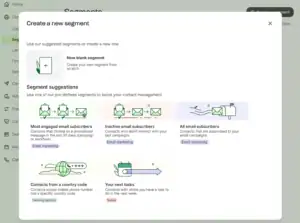
Brevo’s contact management is built around a CRM-style contact record. Each contact stores email engagement history, SMS interaction data, website activity, and any custom attributes you define. The segmentation builder lets you combine multiple conditions across all of this data.
The practical advantage: when your email marketing, SMS campaigns, and CRM conversations all live in the same platform, the segmentation you can build is richer. You can target contacts based on how they have interacted across every channel — not just which emails they opened.
The integration with other Brevo features is also tighter than Constant Contact’s. A contact who completes a specific automation can be tagged, moved to a new segment, and enrolled in a different sequence — all without any manual work.
Winner: Brevo for segmentation depth and CRM-connected contact data. Constant Contact for simple, user-friendly list management that does not require any technical thinking.
CRM
Constant Contact: No built-in CRM
Constant Contact does not have a CRM. Contact management inside the platform covers email list data and basic engagement history. If you need to track deals, manage a sales pipeline, log calls, or see a customer’s full history across touchpoints — you need a separate CRM tool alongside Constant Contact.
For businesses already using HubSpot, Salesforce, or Pipedrive — this is not a dealbreaker. But it is an additional cost and an additional tool to manage.
Brevo: A basic but genuinely useful CRM included
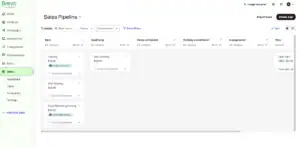
Brevo includes a CRM at no extra charge. You get contact management, deal tracking, pipeline visualisation, and basic task management — all connected to the same contact records that your email campaigns and SMS messages use.
It is honest to say this is not a replacement for HubSpot or Salesforce. An independent reviewer described Brevo’s CRM as too basic to replace dedicated CRM tools for businesses already using them. But for small businesses currently tracking customers in spreadsheets — it is a genuine upgrade that eliminates a separate subscription.
The real value of Brevo’s built-in CRM is the unified view. When a sales conversation, a marketing email, an SMS, and a WhatsApp message all live on the same contact record — you understand that customer’s history without jumping between tools.
Winner: Brevo by default. Constant Contact does not have one.
Forms and Landing Pages
Constant Contact: Solid forms, event registration as a standout

Constant Contact gives you sign-up forms and basic landing pages. The form builder is straightforward. Forms connect directly to your contact lists.
The genuine standout feature is event registration. Constant Contact lets you build event pages, collect RSVPs, send automated event reminders, and manage attendee lists from the same platform as your email campaigns. For nonprofits, community organisations, and event-driven businesses — this eliminates the need for a separate tool like Eventbrite, which can cost $50 to $200 a month. That saving alone can justify Constant Contact’s higher price for event-heavy organisations.
Brevo: Landing pages and forms across all paid plans
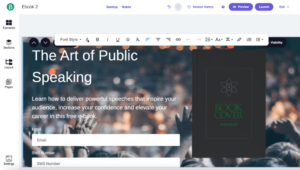
Brevo gives you landing pages and sign-up forms on paid plans. The landing page builder is functional and connects directly to automation workflows — someone submits a form and immediately enters a sequence.
What Brevo does not have: anything close to Constant Contact’s event management tools. No RSVP tracking, no attendee management, no event reminder sequences built around a specific event date. For event-focused organisations, that is a real gap.
Winner: Constant Contact for event-driven organisations — the event management feature is genuinely valuable and hard to replace cheaply. Brevo for everyone else — the landing pages and forms are more flexible and better connected to automation.
Multi-Channel Marketing
This is where Brevo pulls ahead most clearly — and where Constant Contact has the most catching up to do.
Constant Contact: Email first, with SMS as an add-on
Constant Contact covers email, SMS (as a paid add-on), and social media tools. The social media features let you create and schedule posts to Facebook, Instagram, and other platforms from inside Constant Contact. That is useful for small businesses that manage social alongside email from one place.
What Constant Contact does not have: WhatsApp marketing, push notifications, transactional email infrastructure, or live chat. The multi-channel reach is limited to the most common channels and does not go deeper than that.
Brevo: Email, SMS, WhatsApp, push notifications, live chat, and transactional email
Brevo covers more ground than almost any other platform at this price point.
Email marketing, SMS marketing, WhatsApp campaigns, web push notifications, and live chat are all available from the same dashboard connected to the same contact database. A customer can receive a promotional email on Monday, a WhatsApp follow-up on Wednesday, and an SMS reminder on Friday — all triggered from a single automation that reacts to what they do.
The transactional email infrastructure is a separate but significant advantage. Transactional emails are the system emails every ecommerce business and SaaS company needs — order confirmations, shipping updates, password resets, account notifications. Most businesses use a separate tool like SendGrid or Postmark for these. Brevo handles both marketing and transactional emails from one platform, which eliminates that separate subscription.
Winner: Brevo — not close. The combination of email, SMS, WhatsApp, push notifications, live chat, and transactional email at Brevo’s price point is genuinely difficult to match elsewhere.
Deliverability
Deliverability is the percentage of your emails that reach the inbox rather than the spam folder. Both platforms have strong track records here — but the numbers tell slightly different stories.
Constant Contact: 98% claimed inbox rate
Constant Contact claims a 98% inbox delivery rate. That is the number they publish on their own website and in their own marketing materials. Self-reported numbers should always be taken with some caution — but the platform has a long reputation for reliable delivery, and independent reviewers consistently describe deliverability as one of its strongest features.
Constant Contact’s advantage here is partly structural. The platform targets small businesses who are typically sending to permission-based, engaged lists. The sender quality is generally high across the platform, which helps everyone’s deliverability.
Brevo: Strong deliverability with a dedicated infrastructure
Brevo has built dedicated email delivery infrastructure rather than relying entirely on shared third-party providers. The platform processes over 90 million emails a day across its customer base. At that volume, the delivery infrastructure is mature and well-maintained.
Independent reviews consistently rate Brevo’s deliverability as strong. The platform includes tools to monitor your sender reputation, track bounce rates, and manage spam complaints proactively — giving you more visibility into your deliverability health than Constant Contact offers.
One honest note: Brevo’s free plan limits sends to 300 emails per day. That limit is partly a deliverability protection — it prevents new, unverified senders from damaging the shared infrastructure. Once you move to a paid plan, the limit lifts significantly.
Winner: Tie — both platforms deliver strong inbox placement. Constant Contact edges slightly ahead on claimed rates and long-term reputation. Brevo gives you more tools to monitor and maintain your own deliverability proactively.
Integrations
Constant Contact: 300+ integrations with strong small business coverage
Constant Contact connects to over 300 apps. Square, Xero, social media platforms, website builders, Canva, Shopify, WordPress, and Zapier are all there. The Canva integration is a specific standout — if your team creates visual content in Canva, you can pull designs directly into Constant Contact without downloading and re-uploading files.
For a small business using mainstream tools — a Shopify store, a WordPress site, a Square payment terminal — Constant Contact’s integration library covers the common needs cleanly.
Brevo: 150+ native integrations with deeper developer tools
Brevo’s native integration count is lower than Constant Contact’s. But the integrations it has tend to go deeper — particularly for ecommerce and developer-focused use cases.
The WooCommerce integration is native and well-built. The REST API covers marketing campaigns, transactional email, SMS, contact management, and automation from a single well-documented interface. For SaaS companies and development teams that need to build email functionality into their product — Brevo’s API is significantly more capable than Constant Contact’s.
An independent reviewer noted that Brevo has a significant advantage for teams including developers who need to integrate email into their product. Constant Contact’s API is more limited in scope and less frequently updated.
Winner: Constant Contact for total integration count and the Canva connection. Brevo for developer-focused integrations, API depth, and ecommerce-specific connections.
Reporting and Analytics
Constant Contact: Simple reports, easy to read

Constant Contact gives you opens, clicks, bounces, and unsubscribes. The dashboard is clean and the numbers are easy to find. For a small business that just wants to know whether people opened the email and clicked the link — Constant Contact’s reporting answers those questions quickly.
The honest limitation: that is approximately where it stops. There is no heat map showing which links got clicked. No revenue attribution connecting email sends to actual purchases. No detailed automation performance reports. No segmented reporting by contact attribute.
An independent reviewer who tested both platforms described Constant Contact’s reporting as simple and focused on the basics — but noted they would not be able to understand as much as they could from Brevo’s reporting dashboard.
Brevo: Detailed analytics across every channel
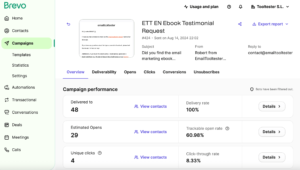
Brevo’s reporting covers opens, clicks, bounces, unsubscribes, conversion tracking, and revenue attribution if you connect your store. Heat maps show which specific links got clicked and how many times. Automation reports show how many contacts entered each sequence, where they dropped off, and what percentage completed the workflow.
Because Brevo covers multiple channels, the reporting goes wider too. SMS delivery rates, WhatsApp open rates, push notification click rates — all visible from the same dashboard alongside your email metrics.
An independent reviewer described Brevo’s reporting as not only more detailed but also more organised and better documented. On the flip side, another reviewer noted that despite Constant Contact’s focus on simplicity, the graph interface can actually look intimidating — counterintuitive for a tool marketed on ease of use.
Winner: Brevo — meaningfully stronger reporting across every metric that matters. Constant Contact is enough for basic tracking. Brevo is where you go when you actually want to optimise.
Pricing: The Full Honest Picture
This is where the comparison becomes most decisive.
Brevo Pricing
Brevo charges based on how many emails you send — not how many contacts you store. This is the most important structural difference between the two platforms.
It means you can have 100,000 contacts in Brevo and pay nothing extra for storing them. You only pay when you actually send to them. For businesses with large lists that do not email everyone every week — or businesses that have accumulated contacts over years — this is a dramatically better model.
The Free plan gives you unlimited contacts stored and up to 300 emails per day (roughly 9,000 per month). Basic email marketing, a landing page builder, and SMS marketing are included. No credit card required. This is a genuinely useful free plan — not a demo.
The Starter plan starts at $9 a month for 5,000 emails per month. No daily sending limit. Basic reporting and email support included.
The Business plan starts at $18 a month for 5,000 emails per month. This is where Brevo becomes genuinely powerful — full marketing automation, A/B testing, advanced statistics, multi-user access, and phone support on higher Business tiers.
The Enterprise plan is custom-priced for high-volume senders and large organisations.
How Brevo costs scale by email volume on Business:
- 5,000 emails/month: $18 a month
- 20,000 emails/month: $25 a month
- 40,000 emails/month: $35 a month
- 60,000 emails/month: $54 a month
- 100,000 emails/month: $69 a month
- 350,000 emails/month: $173 a month
To put these in contact terms: if you have 10,000 contacts and send twice a month — that is 20,000 emails. Brevo Business costs $25 a month for that volume. At the same contact count, Constant Contact costs $80 a month or more.
Constant Contact Pricing
Constant Contact charges based on how many contacts are in your account. The more contacts you have, the higher your bill — regardless of how often you email them.
There is no free plan. After a 30-day free trial, you pay from day one.
The Lite plan starts at $12 a month for up to 500 contacts. Basic email marketing, templates, and limited automation.
The Standard plan starts at $35 a month for up to 500 contacts. Adds more automation tools, better reporting, and contact segmentation.
The Premium plan starts at $80 a month for up to 500 contacts. Adds advanced automation, SEO tools, and Google Ads integration.
How Standard plan costs scale by contact count:
- 500 contacts: $35 a month
- 1,000 contacts: $55 a month
- 2,500 contacts: $70 a month
- 5,000 contacts: $80 a month
- 10,000 contacts: $110 a month
- 25,000 contacts: $175 a month
- 50,000 contacts: $295 a month
The honest Constant Contact pricing problem:
You pay for every contact in your account whether you email them or not. A contact who has not opened an email in two years is still on your bill. Constant Contact does not automatically remove or discount inactive contacts.
Multiple reviewers specifically call this out. One reviewer noted paying $80 a month for basic email and describing it as overpriced. A nonprofit reviewer said the price keeps going up and they are considering alternatives. These are not isolated comments — rising cost relative to what the platform delivers is the most consistent complaint in recent Constant Contact reviews.
Side-by-Side at Common Sending Volumes:
| Scenario | Brevo Business | Constant Contact Standard |
|---|---|---|
| 5,000 contacts, 2x/month (10k emails) | $18/month | $80/month |
| 10,000 contacts, 2x/month (20k emails) | $25/month | $110/month |
| 25,000 contacts, 2x/month (50k emails) | $35/month | $175/month |
At 10,000 contacts sending twice a month, Brevo costs $85 less per month than Constant Contact. That is $1,020 a year. Multiple users who switched describe savings of over $600 a year — and those are conservative estimates based on smaller lists.
Customer Support
This is the one category where Constant Contact genuinely leads — and where its advantage is real enough to change the decision for some businesses.
Constant Contact: Phone support on all paid plans

Constant Contact offers phone support, live chat, and email support on paid plans. Not just on the expensive tiers — on all of them. If your campaign breaks at 2pm on a Tuesday and you need to talk to a real person immediately, you can call Constant Contact.
For small business owners who are not technical and who depend on their email tool to work reliably for time-sensitive campaigns — the availability of phone support is genuinely valuable. One reviewer said phone support is the main reason they stay with Constant Contact despite the high price. That is an honest, reasonable position.
The support team is consistently described as warm, responsive, and helpful in real conversations. The community, tutorials, and how-to content are also well-developed for beginners.
Brevo: Email and chat support, phone only on Pro
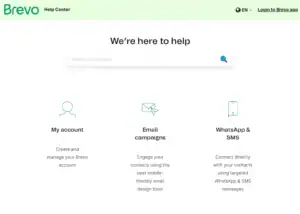
Brevo offers email support on all paid plans and live chat on Business plans. Phone support is only available on the Pro plan at $449 a month — which is a significant jump for a small business that just needs occasional phone help.
Multiple independent reviewers mention this as the main downside of Brevo. One reviewer described the multi-channel capabilities as solid but said that when things go wrong, you are stuck waiting for chat responses. That is a fair criticism for businesses where email is time-sensitive and downtime is costly.
The Brevo knowledge base and help documentation are solid. Most common issues can be resolved through the documentation or community. But for users who need the confidence of speaking to a person — Brevo’s support structure is a real disadvantage.
Winner: Constant Contact — clearly. Phone support on all paid plans is a meaningful advantage that Brevo simply does not match outside its Pro tier.
What Real Users Are Actually Saying
I went through hundreds of reviews on G2, Capterra, Software Advice, and independent comparison sites. Here are the patterns that show up consistently.
On Brevo’s value after switching from Constant Contact:
This is the most common narrative in Brevo’s recent reviews. Multiple users describe switching from Constant Contact, saving between $600 and $1,200 per year, and gaining SMS marketing and transactional email as part of the move. One reviewer said switching to Brevo saved them over $600 a year and they gained SMS marketing — adding that eliminating the need for a separate transactional email service was an added bonus. The phrase “no regrets” shows up in several of these reviews.
On Constant Contact’s pricing frustration:
Rising prices relative to features is the most consistent complaint in long-term Constant Contact reviews. One reviewer paying $80 a month for basic email described feeling it was overpriced. A nonprofit using the platform for event invitations and follow-ups said the price keeps going up and they are considering alternatives. These are not edge cases — they are the dominant sentiment in reviews from users who have been on the platform for more than a year.
On Constant Contact’s phone support value:
This comes up as a genuine positive in nearly every review that does not focus on price complaints. Users describe the support team as helpful, responsive, and available when needed. For some businesses — particularly those without any in-house technical expertise — the availability of a phone call is described as the deciding factor that keeps them on the platform despite the cost.
On Brevo’s automation depth:
The automation capability gets consistent praise from users who have moved beyond basic email. Multiple reviewers describe building behaviour-triggered sequences that Constant Contact could not support — website visit triggers, conditional branching, transactional event automation. The consensus is that Brevo’s automation is meaningfully more capable while remaining accessible to users who are not developers.
On Brevo’s learning curve:
Honest reviews acknowledge a short adjustment period at the start. Brevo is not hard — but it is not as instantly intuitive as Constant Contact. The reviewers who describe the biggest learning curve tend to be those with no prior email marketing experience. Most describe getting comfortable within a week or two.
My Honest Take After Testing Both
Here is where I land after using both platforms on real accounts.
Brevo is the better tool for the vast majority of businesses comparing these two platforms. The pricing model is more honest — you pay for what you send, not for contacts that are just sitting in your account. The automation is meaningfully more capable. The multi-channel reach — email, SMS, WhatsApp, push notifications — is in a different league. The CRM is included. The deliverability tools give you more control. And the cost savings versus Constant Contact are significant enough at any list size to matter to a real business budget.
The learning curve is real but short. The support limitation is real and worth acknowledging. If your business genuinely needs phone support as a safety net and you are not willing to pay for Brevo’s Pro plan — that is a legitimate reason to stay with Constant Contact.
Constant Contact still earns its place for a specific type of business. Nonprofits running events, community organisations managing RSVPs, and local businesses that need the confidence of phone support and the simplest possible interface will find Constant Contact worth the premium. The event management tools alone can eliminate a $50 to $200 per month Eventbrite subscription and that saving narrows the price gap considerably.
you can also check out these Constant contact Alternatives
But for any business that plans to do more than send basic newsletters — that needs automation to do actual work, that wants to reach customers across more than one channel, that has a list larger than 2,500 contacts — the math consistently points to Brevo. while you can also check out these Brevo Alternatives
Frequently Asked Questions
Is Brevo better than Constant Contact?
For most businesses — yes. Brevo offers more features, lower pricing, a free plan, multi-channel marketing, a built-in CRM, and stronger automation. Constant Contact is better for event-based organisations, nonprofits, and businesses where phone support is non-negotiable.
Does Brevo have a free plan?
Yes. Brevo’s free plan gives you unlimited contact storage and up to 300 emails per day — roughly 9,000 per month. No credit card required. It includes basic email marketing, a landing page builder, and SMS marketing access. Constant Contact has no free plan — only a 30-day free trial.
Why is Constant Contact more expensive than Brevo?
Constant Contact charges based on how many contacts you store. Brevo charges based on how many emails you send. If you have 10,000 contacts but only email them twice a month, Constant Contact charges you for 10,000 contacts whether you use them or not. Brevo charges you only for the 20,000 emails you actually send. That structural difference makes Brevo significantly cheaper for most sending patterns.
Does Brevo have phone support?
Phone support is only available on Brevo’s Pro plan starting at $449 a month. Lower paid plans get email support and live chat on Business plans. If phone support is important to you and you cannot justify the Pro plan price, Constant Contact is the better choice on this specific dimension.
Can I send SMS with both tools?
Yes — but differently. Brevo includes SMS marketing as a native feature across its paid plans with SMS credits purchased separately. Constant Contact offers SMS as a paid add-on. Brevo’s SMS capability is more integrated with automation and CRM data.
Is Constant Contact good for nonprofits?
Yes — particularly if you run events. The event registration features, RSVP tracking, and attendee management tools are genuinely useful for nonprofits and community organisations. Constant Contact also offers a nonprofit discount. For nonprofits that do not run events, Brevo’s lower pricing and better automation are harder to argue against.
What is the best alternative to both Constant Contact and Brevo?
MailerLite offers a similar feature set to Brevo at comparable pricing with a cleaner interface. ActiveCampaign is the better choice if you need deeper automation and a CRM for B2B or service businesses. Klaviyo is the better choice if you run an ecommerce store and need advanced product-level automation.
