
Last Updated: 31 Jul 2026
I used both Brevo and Klaviyo for months, on a real list, not a demo account. Real campaigns, real automations, real moments of staring at a dashboard wondering why a flow did not fire.
Here is the short version of why people even ask this question. Brevo and Klaviyo look like they compete, but they were not built for the same person. Brevo was built to be one simple home for email, SMS, WhatsApp, live chat, and a basic CRM, at a price almost any small business can afford. Klaviyo was built for online stores that live and die by revenue per email, and it prices itself like it knows that.
If you sell a physical product online, this Brevo vs Klaviyo comparison matters a lot. If you run a blog, a service business, or a newsletter, it matters in a different way. Keep that in mind as you read, because the winner changes depending on which one you are.
Short on Time? Read This First
Brevo is the cheaper, easier, more complete general tool. If you want email, SMS, WhatsApp, and a free CRM in one place, without needing a business degree to set it up, Brevo is the easier pick for almost every small business.
Klaviyo is built to squeeze more revenue out of an online store. If you run a Shopify or WooCommerce store with real order volume, its ecommerce automations and revenue reporting go deeper than anything Brevo offers.
Neither one is the right tool for a business that is not ready to invest time in automation. Klaviyo especially punishes casual use, because you pay by contact count no matter how often you actually email them.
| Feature | Brevo | Klaviyo |
|---|---|---|
| Free plan | 300 emails a day, unlimited contacts | 250 profiles, 500 emails a month |
| Cheapest paid plan | 9 dollars a month | 20 dollars a month |
| Pricing model | Based on emails sent | Based on contact count |
| How it charges as you grow | Stays cheap with a big list you rarely email | Climbs fast the moment your list grows |
| Email editor style | Clean drag and drop, brand library | Drag and drop, built around product blocks |
| Built for | General small business communication | Ecommerce stores, mainly Shopify |
| Automation depth for stores | Decent, not ecommerce specific | Deep, purpose built for online stores |
| CRM | Built in, free, sales pipeline included | Customer data platform, not a sales CRM |
| Best for | Newsletters, service businesses, budget-conscious teams | Online stores with real order volume |
GET STARTED WITH Brevo FOR FREE NOW
Built for stores that want revenue-driven email
GET STARTED WITH Klaviyo FOR FREE NOW
How I Tested Both Tools
I paid for both tools and ran a real list through each one for several months. I built the same welcome flow on both, sent real weekly campaigns, and connected a small store to test the ecommerce side of things. I also read through hundreds of reviews on G2, Capterra, and Trustpilot, because my one experience is one story. Thousands of reviews tell you whether what I saw is normal.
Brevo vs Klaviyo – Ease of Use
Brevo: simple from the first login
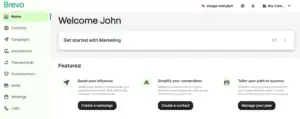
Brevo does not make you learn a new way of thinking before you can send an email. Lists, campaigns, and automations all work the way most people already expect. I sent my first campaign inside an hour, without opening a help article.
Reviewers on Capterra and G2 say the same thing over and over. New users get comfortable fast, and small teams do not need a dedicated specialist to run the platform day to day.
Klaviyo: powerful, but it wants your attention first
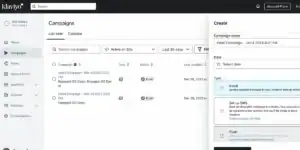
Klaviyo is not confusing exactly, but it is dense. The dashboard throws profiles, flows, segments, campaigns, and metrics at you right away. If you already know email marketing, you will find your footing in a week. If you are new to it, expect a slower start.
Reddit threads about switching to Klaviyo repeat a common pattern. People say the first few days feel like too much, and then something clicks once they understand how profiles and flows connect to actual orders.
Winner: Brevo, for getting a beginner sending real campaigns without a learning curve. Klaviyo rewards patience, but it does ask for patience up front.
Email Editor
Brevo: clean, fast, and consistent
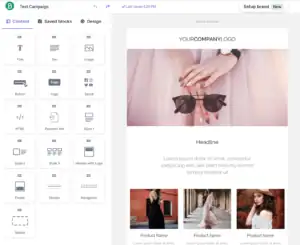
Brevo’s drag and drop editor is one of its strongest points. Blocks are clearly labeled, moving things around is smooth, and the Brand Library is a genuine time saver. Set your logo, colors, and fonts once, and every new email picks them up automatically. There is also a built in image editor and an AI writing assistant for subject lines and body copy on paid plans.
Klaviyo: built around your product catalog
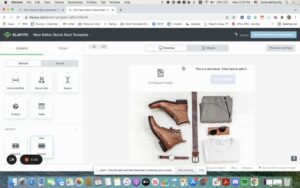
Klaviyo’s editor covers the basics well, but its real strength is how tightly it connects to your store. You can drop in a live product feed, pull in dynamic pricing, or show a customer items based on what they already browsed. That is not something Brevo’s editor is built to do.
The tradeoff is complexity. Building a simple newsletter in Klaviyo takes about the same effort as Brevo. Building something that pulls live product data takes real setup time.
Winner: Tie, but for different reasons. Brevo wins for speed and simplicity on a standard newsletter. Klaviyo wins the moment your email needs to talk to your product catalog.
Templates, Design, and Quality
Brevo: a smaller, general purpose library

Brevo ships with around 48 templates covering newsletters, promotions, events, and welcome emails. They look modern and mobile friendly, and the Brand Library keeps everything on brand without extra work. The library is on the smaller side compared to some general email tools, but it covers what most small businesses actually send.
Klaviyo: bigger, and shaped for stores
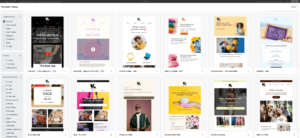
Klaviyo’s template library is larger and leans heavily toward ecommerce. Product grids, review blocks, countdown timers for sales, and abandoned cart layouts are all ready out of the box. If you sell physical products, the templates already look like something a store would send, without much editing.
Winner: Klaviyo, for stores specifically. The template quality and ecommerce focus give it a real edge if you are selling products. For a general newsletter or service business, Brevo’s smaller library is easier to work with and just as polished.
List Management and Automation
Brevo: solid, multichannel, and included on the free plan
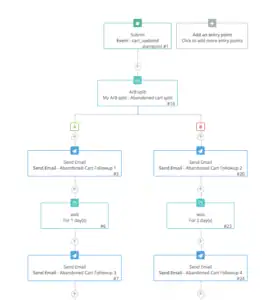
Brevo gives you automation on every plan, including the free one. That alone puts it ahead of most competitors. The builder handles if or else branching, time delays, and behavior based triggers cleanly, and it shows your whole flow on one screen.
What makes Brevo genuinely different is that a single automation can combine email, SMS, and WhatsApp. A cart reminder can send an email at thirty minutes, a text two hours later, and a WhatsApp message the next day, all from one flow and one subscription.
Segmentation uses simple and or logic on contact data, engagement, and website activity, and it is available even on the free plan.
Klaviyo: built specifically to grow store revenue
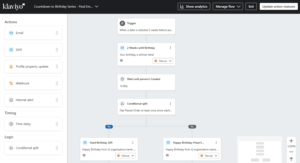
Klaviyo’s automation is where it earns its price tag. The flow library is stacked with ecommerce specific sequences: abandoned cart, browse abandonment, back in stock alerts, post purchase follow ups, and win back campaigns for lapsed buyers. Each flow already knows how to react to store events like a purchase, a product view, or a checkout that never finished.
Segmentation goes further too. Klaviyo can build a segment around predicted customer lifetime value, churn risk, or how likely someone is to buy again, using its own predictive models. That kind of segmentation is simply not something Brevo tries to do.
The catch is depth versus breadth. Klaviyo’s automation lives almost entirely inside the store relationship. If your business is not selling a product, most of that power goes unused.
Winner: Klaviyo, for stores. The purpose built ecommerce flows and predictive segmentation are ahead of anything Brevo offers. For a business that is not selling products directly, Brevo’s simpler, multichannel automation covers more real ground.
Deliverability
Deliverability numbers move around depending on who runs the test and when. Independent testing over the past year has shown both tools landing in a similar range for well authenticated senders, generally somewhere in the high eighties to mid nineties for inbox placement.
Brevo has a real, well documented issue that shows up again and again in reviews: accounts getting suspended or flagged with little warning, sometimes even with healthy open rates. It usually gets resolved within a couple of days after contacting support, but it is a genuine risk worth knowing before you move your whole list over.
Klaviyo does not have that same suspension pattern in reviews, but its list hygiene rules are stricter in a different way. Because you pay by active profile, keeping unengaged contacts around costs you money and can drag down your sender reputation at the same time. You end up needing to clean your list regularly just to control both cost and deliverability.
Winner: Tie. Both platforms deliver well when you follow good sending practices. Brevo’s risk is a sudden account flag. Klaviyo’s risk is a slowly bloated, unengaged list that costs you twice, once in deliverability and once in your bill.
Integrations
Brevo: broad, general business coverage
Brevo connects natively to around 150 tools, covering Shopify, WooCommerce, WordPress, Salesforce, HubSpot, Stripe, and Google Analytics, with Zapier for the rest. It also has a well documented API that developers like for sending transactional email from their own apps.
Klaviyo: narrow, but deep where it counts
Klaviyo connects to more than 350 platforms, and almost all of that depth points toward ecommerce. Shopify is practically a first party experience. WooCommerce, Magento, and BigCommerce are all well supported, and the data sync between your store and Klaviyo is detailed down to individual product views and cart contents.
Winner: Klaviyo, for raw integration count and ecommerce depth. Brevo wins if your tool stack looks like a general small business rather than an online store.
CRM
Brevo: a real, free sales CRM
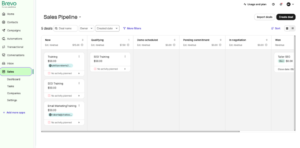
Brevo includes an actual CRM with deal tracking and a sales pipeline, free on every plan including the no cost tier. It is not going to replace Salesforce for a large sales team, but for a small business that wants to track leads and deals without paying for a separate tool, it is a genuine bonus.
Klaviyo: a customer data platform, not a sales CRM
Klaviyo calls itself a CRM in its marketing, but it means something different by that. There is no deal pipeline or sales stage tracking. What you get instead is a unified customer profile that pulls together every order, email interaction, and website visit into one record per person. It is built to help you understand and market to a customer, not to manage a sales process.
Winner: Brevo, if you actually need a sales pipeline. Klaviyo’s customer data platform is excellent at what it does, but it is solving a different problem, and it is not a fair swap for a traditional CRM.
Customer Support
Brevo: responsive, even for free users
Brevo’s support gets consistently good marks across review sites, and users specifically call out that even free plan support responds and actually helps, rather than just filing a ticket. Paid plans add priority support and phone access on higher tiers.
Klaviyo: solid while you are on a paid plan, thin before that
Klaviyo offers email and chat support, but no phone support on any plan. The bigger issue is the free plan: support access ends after the first sixty days, after which you are on your own with the community forum and help docs. For a new store still learning the platform, that cutoff can land at an inconvenient time.
Winner: Brevo, mainly because of how it treats free and early users. Klaviyo’s paid support is fine, but the sixty day cutoff on the free plan is a real gap.
Reports and Analytics
Brevo: clear basics, real time stats
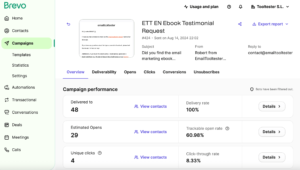
Brevo gives you opens, clicks, bounces, and unsubscribes, plus click heat maps that show exactly where people clicked inside an email. Stats update in real time as a campaign goes out, which is genuinely useful for watching a launch unfold. Revenue tracking is available if you connect a store, but it stays fairly basic.
Klaviyo: reporting built around revenue
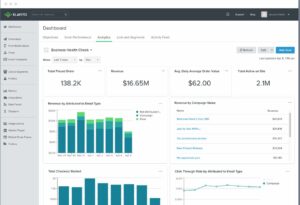
This is where Klaviyo pulls ahead by a wide margin. Every flow and campaign ties back to actual revenue generated, not just opens and clicks. You can see revenue per recipient, compare flows against each other, and use predictive analytics to flag which customers are likely to churn or which ones are worth the most over time. For a store trying to justify its marketing spend, this kind of reporting answers the question that actually matters: did this email make money.
Winner: Klaviyo, clearly. The revenue attached reporting and predictive analytics are built for a level of decision making that Brevo’s reports do not attempt to reach.
Pricing
Brevo: pay for what you send, not who you have
Brevo prices by email volume, not contact count. The free plan allows unlimited contacts and 300 emails a day, which is enough for a real small business newsletter. Paid plans start at 9 dollars a month, and a business with a large list that emails occasionally can end up paying very little. The catch: the free plan carries Brevo branding, and full automation plus landing pages sit on the Business plan at 18 dollars a month and up.
you can also check out Brevo alternatives here
Klaviyo: pay for your list size, no matter how often you email
Klaviyo charges by active profile count. The free plan covers only 250 profiles and 500 emails a month, and support disappears after sixty days. Paid plans start at 20 dollars a month for up to 500 profiles, and the cost climbs steeply from there, landing around 175 dollars a month at 5,000 contacts and roughly 350 dollars a month at 10,000. There are no annual discounts, so the price you see is the price you pay every month.
| Subscribers | Brevo | Klaviyo | Monthly Savings with Brevo |
|---|---|---|---|
| Up to 500 | 9 dollars | 20 dollars | 11 dollars |
| Up to 1,000 | 18 dollars | about 45 dollars | 27 dollars |
| Up to 5,000 | 27 dollars | about 175 dollars | 148 dollars |
| Up to 10,000 | 57 dollars | about 350 dollars | 293 dollars |
Winner: Brevo, by a wide margin, for cost. If your business only sends a couple of campaigns a month to a large list, Brevo’s model rewards you. Klaviyo’s model charges you the same whether you email daily or once a season, and that adds up fast.
Get Started With Brevo Now for FREE
Get Started With Klaviyo for Free
What Each Tool Is Actually Best At
Brevo’s specialty is being one affordable home for every channel a small business actually uses. Email, SMS, WhatsApp, live chat, and a free CRM, all under one login, at a price that does not punish you for having a big list.
Klaviyo’s specialty is turning an online store’s data into money. The predictive segments, the revenue reporting tied to every flow, and the deep Shopify connection are built for one job: getting more revenue out of the customers you already have. It does that job better than almost anything else on the market.
My Honest Take After Testing Both
If I am being straight with you, Brevo felt like the tool built for a business that needs to communicate well without overspending. Klaviyo felt like a tool built by people who understand ecommerce revenue down to the decimal point, and priced it accordingly.
Neither tool is trying to be the other. Klaviyo is not trying to be cheap, and Brevo is not trying to out-predict Klaviyo on customer behavior. Pick based on what your business actually is, not on which tool has more features on paper.
Before You Commit to Either Platform
Pick Brevo if you run a service business, a blog, or a general small business that wants email, SMS, and a basic CRM without a big monthly bill. Pick Brevo if your list is large but you do not email it every day. Pick Brevo if you want automation and a real CRM on a free plan.
Pick Klaviyo if you run an online store with steady order volume. Pick Klaviyo if you want flows that already understand abandoned carts, back in stock alerts, and win back campaigns. Pick Klaviyo if seeing exact revenue per email matters more to you than keeping the bill low.
Frequently Asked Questions
Q. Is Brevo or Klaviyo cheaper?
Brevo is cheaper at almost every list size, mainly because it charges by emails sent rather than contact count. Klaviyo’s pricing climbs fast as your list grows, regardless of how often you actually email people.
Q. Which one is easier for a beginner?
Brevo. Its layout matches what most people already expect from an email tool, and you can send a real campaign within your first hour. Klaviyo takes longer to feel comfortable in, especially if you have never used a data heavy marketing tool before.
Is Klaviyo only for ecommerce?
Not officially, but in practice yes. Its templates, flows, and reporting are all built around store data like orders and product views. A business without a store can use it, but most of what makes Klaviyo worth the price goes unused.
Does Brevo have ecommerce features?
Yes, it connects to Shopify and WooCommerce and includes basic revenue tracking. But its automation and reporting are general purpose, not built specifically around store behavior the way Klaviyo’s are.
Which tool has better customer support?
Brevo, mainly because free plan users still get responsive help. Klaviyo’s support is solid on paid plans but cuts off after sixty days on the free plan.
Which one should an online store actually choose?
In most cases, Klaviyo. The ecommerce specific flows, predictive segmentation, and revenue reporting are built for exactly that job, and stores with real order volume tend to earn back the higher price.
